
Babirusa
바비루사
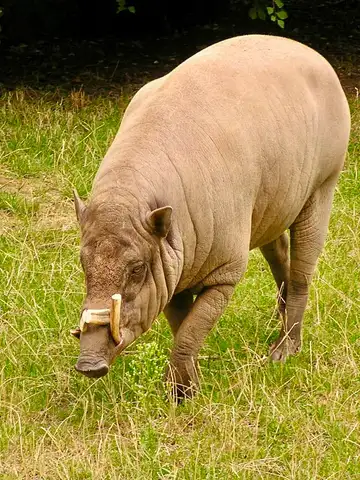
A wild pig of Sulawesi. In males the upper canine tusks pierce through the skin of the snout and curl backward over the face. It has almost no hair and forages in swampy forest for fruit and roots.
See it on the 3D globe →At a glance
- Class
- Mammals
- Lives in
- Forests of Sulawesi, Indonesia
- Diet
- Eats both plants and meat (omnivore)
- Conservation status
- Vulnerable (IUCN VU)
- Habitat
- rainforests
Quick answers
Where does the Babirusa live?
It lives in rainforests. On the globe you can find it near Forests of Sulawesi, Indonesia.
What does the Babirusa eat?
Its diet: eats both plants and meat (omnivore).
Is the Babirusa endangered?
It is listed as Vulnerable (IUCN VU).
Babirusas, also called deer-pigs, are wild pigs from the Indonesian islands of Sulawesi, Togian, Sula and Buru. The name comes from Malay, babi rusa, and means 'pig-deer'. They live in tropical rainforest, often along river banks, and they are active in the daytime. The best-known species, the North Sulawesi babirusa, has such short hair that it looks bald.
The males carry one of the strangest sets of tusks in the animal kingdom. The upper canines grow almost straight up, pierce the skin of the snout and curl backward over the face towards the forehead. The lower canines point upward too. Until 2002 all babirusas were counted as one species; they were then split into several, and all of them are now listed as threatened by the IUCN.
The tusks
In males, the upper canines emerge vertically from the jaw and curve back over the face, while the lower canines also grow upwards. Females have small tusks or none. The shape depends on the species: the North Sulawesi babirusa has long, thick upper tusks, while the golden and Togian babirusas have shorter, slimmer ones. Males use the tusks when they fight, the upper pair for defence and the lower pair as weapons. If a male does not wear them down, they can keep growing and, rarely, even push into his own skull.
Food and family life
Like other pigs, babirusas are omnivores. They eat leaves, roots, fruit and some animal food, and their strong jaws can crack hard nuts. Because they lack a snout bone, they do not dig with their noses the way other pigs do, except in mud and swampy ground. Males tend to live alone. Females live in groups with their young, usually with no more than three adult females, and a mother usually has one or two piglets at a time.
People and babirusas
Babirusas have been part of human life for a very long time. Cave paintings of babirusa on Sulawesi have been dated to at least 35,400 years ago, from the Ice Age. Their odd faces have inspired demon masks in Indonesia, and painted babirusa figures decorate the ceilings of old Balinese halls. Today babirusas are protected in Indonesia and killing them is mostly illegal, but poaching and logging, which destroys their forest home, still threaten them.
Fun facts
- A male's upper tusks grow up through the top of its snout and curve back toward its forehead.
- A male's upper tusks grow up through its snout.
- Cave paintings of babirusas on Sulawesi are at least 35,400 years old.
- Its name means 'pig-deer' in Malay.
- A male's tusks that are never worn down can rarely grow into his own skull.
On the globe
The model shows a hairless wild pig with tusks curling over its face, as in the card. Look at the curved tusks.
More like this

Sources
Updated: 2026-10-14