
Philippine tarsier
안경원숭이
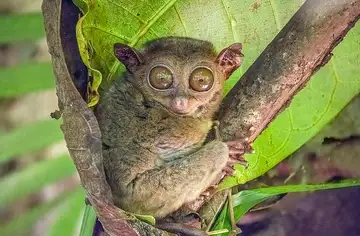
A tiny primate of Bohol, Samar and nearby Philippine islands, only about 10 to 15 cm long. Its huge eyes cannot move in their sockets, so it turns its head almost 180 degrees. It hunts insects at night.
See it on the 3D globe →At a glance
- Class
- Mammals
- Lives in
- Bohol, Samar, Leyte and Mindanao, Philippines
- Diet
- Insect eater
- Weight
- about 0.12 kg
- Conservation status
- Near Threatened (IUCN NT)
- Habitat
- rainforests
Quick answers
Where does the Philippine tarsier live?
It lives in rainforests. On the globe you can find it near Bohol, Samar, Leyte and Mindanao, Philippines.
How big is the Philippine tarsier?
It grows to about 0.12 kg.
What does the Philippine tarsier eat?
Its diet: insect eater.
Is the Philippine tarsier endangered?
It is listed as Near Threatened (IUCN NT).
The Philippine tarsier is a tiny night-time primate that lives only in the southeastern Philippines, mainly on the islands of Bohol, Samar, Leyte and Mindanao. Its body is about 10 to 15 centimetres long, with a tail about twice that, and it weighs around 80 to 160 grams, a little more than a few eggs.
Its huge round eyes are as big as its brain. They cannot move in their sockets, so a tarsier turns its head almost 180 degrees to look around. At night it jumps between branches and snatches insects. It belongs to a family about 45 million years old and is listed as near threatened.
Eyes, ears and legs
The name tarsier comes from the tarsus, an extra-long ankle bone that makes the back legs strong for leaping. The big eyes help it see in dim light, and its big ears are able to move to listen for insects. It hunts insects at night. The tarsier's ancestors go back about 45 million years. It is known locally as mawumag in Cebuano and by other names in other Philippine languages.
Names and protection
In local languages the tarsier is called mawumag or mago. In 2010 scientists placed it in its own genus, Carlito, named after the Filipino conservationist Carlito Pizarras, who protected tarsiers on Bohol. Tarsiers are protected by law in the Philippines, and Bohol has a sanctuary where visitors can see them quietly, without flash photography or touching.
Fun facts
- Each eye is about as big as its brain.
- It can turn its head nearly 180 degrees.
- Its genus name Carlito honours a Filipino conservationist.
- The tarsier family is about 45 million years old.
On the globe
On the toy globe the tarsier clings to a branch in the forests of Bohol, Samar, Leyte and Mindanao. Look for the huge eyes.
Quiz time
Which is heavier: Philippine tarsier or Tamaraw?
Show the answer
Tamaraw. (0.12 kg vs 240 kg) Tamaraw →
More like this
_Bohol_2.jpg)
Sources
Updated: 2026-10-14