
Banded sea krait
바다뱀(띠바다뱀)
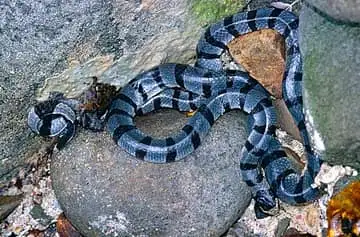
A sea snake with alternating pale and dark bands that hunts eels in coral crevices. It breathes air through lungs, surfacing regularly, and swims with a paddle-shaped tail. Unusually, it comes ashore to rest and lay eggs.
See it on the 3D globe →At a glance
- Class
- Reptiles
- Diet
- Fish eater
- Conservation status
- Least Concern (IUCN LC)
- Habitat
- coral reefs, coasts
Quick answers
Where does the Banded sea krait live?
It lives in coral reefs, coasts of the Indian and Pacific oceans.
What does the Banded sea krait eat?
Its diet: fish eater.
Is the Banded sea krait endangered?
It is listed as Least Concern (IUCN LC).
The yellow-lipped sea krait (Laticauda colubrina), also called the banded sea krait, is a highly venomous snake of tropical Indo-Pacific waters. It lives from the east coast of India along the Bay of Bengal and Southeast Asia to the Malay Archipelago, southern China, Taiwan and the Ryukyu Islands of Japan, and it is common around Fiji and other Pacific islands. It has black rings on a bluish-grey body, a yellow snout and upper lip, and a paddle-shaped tail for swimming.
It spends much of its time under water hunting eels and small fish, but it comes back to land to digest, rest, shed its skin and lay eggs. Because it likes the shore, it often meets people, yet it is not aggressive and bites only when it feels threatened. Males average about 87 centimetres long, while females are much larger, averaging about 1.4 metres.
Half sea, half land
Young kraits stay in the water and along the coast, but adults spend about half their time on land and half in the sea. Females hunt in deeper water, while males hunt in shallower water and are more active on land during mating. Since males are smaller, they crawl and swim faster than females.
The paddle-like tail helps in swimming, but it makes crawling harder. Still, on land the snake can move at a bit more than a fifth of its swimming speed, while most other sea snakes are almost stranded.
A loyal homebody
Though it often hunts far from shore, each snake returns to its own home island. In a test in Fiji, snakes moved 5.3 kilometres to other islands and, when recaptured, were found back on their home islands after about 31 days on average.
Hunting is often solitary, but kraits sometimes join giant trevally and goatfish in a hunting party. The snakes flush prey out of narrow crevices, and the fish eat the escapees, a technique similar to the moray eel's.
Strong venom, resistant eels
The venom is a powerful neurotoxin that blocks signals at nerve connections. A very small dose is lethal to mice. Eels are its main food, and some eels may have evolved resistance to the venom.
In one test, moray eels from the Caribbean, where the snake does not live, died from doses as small as 0.1 milligrams per kilogram. Eels from New Guinea, where it does live, tolerated up to 75 milligrams per kilogram without severe injury. In New Zealand, where a few wanderers have been found, the snake is protected by law.
Fun facts
- Unlike many sea snakes, it comes ashore to rest, digest its food and lay eggs.
- It comes ashore to rest, digest and lay eggs.
- Females grow far longer than males.
- Its tail is shaped like a paddle.
- Some of its prey, eels, may resist its venom.
On the globe
The toy model shows a banded sea krait swimming in warm tropical seas of the Indian and Pacific oceans.
More like this
_(14641328165).jpg)
Sources
Updated: 2026-10-14