
Saltwater crocodile
바다악어(솔트워터 크로커다일)
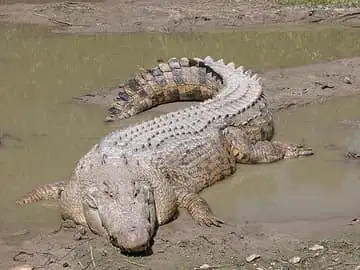
The saltwater crocodile is the largest living reptile, with big males over 5 m long and close to a tonne. It can swim across open sea to reach far-off islands, and ambushes prey that comes near the water's edge.
See it on the 3D globe →At a glance
- Class
- Reptiles
- Diet
- Meat eater (carnivore)
- Weight
- about 400 kg
- Length
- about 3.6 m
- Top speed
- about 29 km/h
- Lifespan
- up to about 70 years
- Conservation status
- Least Concern (IUCN LC)
- Habitat
- wetlands, coasts, rivers & lakes
Quick answers
Where does the Saltwater crocodile live?
It lives in wetlands, coasts, rivers & lakes of the Indian and Pacific oceans.
How big is the Saltwater crocodile?
It grows to about 3.6 m and 400 kg.
What does the Saltwater crocodile eat?
Its diet: meat eater (carnivore).
How fast is the Saltwater crocodile?
It can reach about 29 km/h.
How long does the Saltwater crocodile live?
It can live up to about 70 years.
Is the Saltwater crocodile endangered?
It is listed as Least Concern (IUCN LC).
The saltwater crocodile is the largest living reptile in the world. Big males reach about 6 metres and weigh 1,000 to 1,500 kilograms, while females are much smaller and rarely longer than 3 metres. It has a broad snout, and the scales on its back have a distinctive pattern.
It lives in salty and brackish waters and in freshwater rivers, from the east coast of India across Southeast Asia to northern Australia and Micronesia. It is a top predator that ambushes almost any animal that enters its territory, from fish and crabs to birds and mammals, then drowns or swallows its prey whole. It is dangerous to humans. The IUCN has listed it as Least Concern since 1996.
Swimming across the sea
Despite its name, the crocodile does not live only in salt water, but it can swim long distances through the sea, which is why it has reached faraway islands. It was hunted for its skin right up to the 1970s, and illegal killing and habitat loss still threaten it in some places. Today it is only one species, with no subspecies officially recognised.
A very old family
Fossils of a saltwater crocodile from northern Queensland date back to the Pliocene. Its closest living relatives are the Siamese crocodile and the mugger crocodile. Scientists once described several saltwater crocodile forms as separate species, but now treat them all as the same one. One genetic study suggests that the whole genus Crocodylus may have started in Africa and then spread towards Southeast Asia and the Americas. The saltwater crocodile is also called the estuarine crocodile, the marine crocodile or, informally, the saltie.
Fun facts
- It can swim long distances out at sea and is sometimes found far from land.
- It is the largest living reptile.
- It can swim far out to sea to reach remote islands.
- Females rarely grow longer than 3 metres, while males can be twice that long.
On the globe
The globe shows the saltwater crocodile in the coastal waters of Southeast Asia and northern Australia. Look for the huge broad-snouted crocodile.
Quiz time
Which is heavier: Saltwater crocodile or Komodo dragon?
Show the answer
Saltwater crocodile. (400 kg vs 70 kg) Komodo dragon →
More like this
.jpg)
Sources
Updated: 2026-10-14