
Beluga sturgeon
벨루가철갑상어
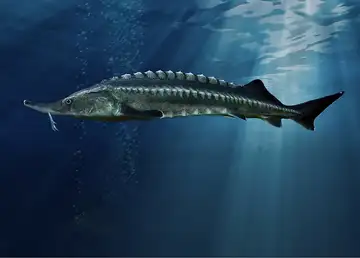
A giant sturgeon of the Caspian and Black Seas with rows of bony scutes, a shovel-shaped snout and barbels. It can exceed 5 m and live close to a century. Its eggs are the famous beluga caviar, and overfishing has pushed it to the brink.
See it on the 3D globe →At a glance
- Class
- Fish
- Lives in
- Caspian & Black Seas, Volga and Ural rivers
- Diet
- Fish eater
- Length
- about 2.3 m
- Lifespan
- up to about 100 years
- Conservation status
- Critically Endangered (IUCN CR)
- Habitat
- rivers & lakes, coasts
Quick answers
Where does the Beluga sturgeon live?
It lives in rivers & lakes, coasts. On the globe you can find it near Caspian & Black Seas, Volga and Ural rivers.
How big is the Beluga sturgeon?
It grows to about 2.3 m.
What does the Beluga sturgeon eat?
Its diet: fish eater.
How long does the Beluga sturgeon live?
It can live up to about 100 years.
Is the Beluga sturgeon endangered?
It is listed as Critically Endangered (IUCN CR).
The beluga sturgeon, or great sturgeon, is a giant fish of the Caspian and Black Sea basins. It used to live in the Adriatic Sea too. By its largest size it is the third-heaviest living bony fish, and it is one of the most famous fish in the world because its eggs are sold as beluga caviar.
Because people fished it so hard for those eggs, wild numbers fell sharply. The IUCN now lists the beluga sturgeon as critically endangered, the last step before extinct in the wild. It is not related to the beluga whale; both names come from the Russian word for white.
A body built like an armoured ancient fish
Like other sturgeons, the beluga has a long body, a partly cartilage skeleton, no ordinary scales and rows of bony plates called scutes. It has a big crescent-shaped mouth and two pairs of leafy barbels, feelers near the mouth. Young fish are slim and dark grey with a white belly, while adults are heavy-set, humpbacked and have a massive head. The mouth is large, crescent-shaped and can be pushed out, and the snout is cone-shaped with many sensory pits to feel its surroundings. The skin is covered with fine tooth-like denticles instead of scales.
Why is it endangered?
Sturgeons are anadromous: they grow up in the sea but swim up rivers to breed. Female beluga sturgeons carry valuable roe, so overfishing and poaching have been very heavy. Today fewer fish survive to reach the rivers, which is why protecting both the fish and their rivers matters. Female roe is so valuable that a single fish can be worth a great deal, which is why poachers still target the species in the Caspian region. Conservation groups and governments try to protect spawning rivers.
Fun facts
- Its eggs are sold as beluga caviar, one of the most expensive foods in the world.
- The beluga sturgeon is the third-most-massive living species of bony fish.
- Its name and the beluga whale's both come from the Russian word for white.
- It breeds in rivers even though it grows up in the sea.
On the globe
The model shows a giant sturgeon with rows of plates along its back and feelers near its mouth. Look for it around the Caspian and Black Seas.
Quiz time
Which is longer: Beluga sturgeon or Green moray eel?
Show the answer
Beluga sturgeon. (2.3 m vs 1.8 m) Green moray eel →
More like this
.jpg)
Sources
Updated: 2026-10-14