
Oceanic whitetip shark
바다흰배지느러미상어
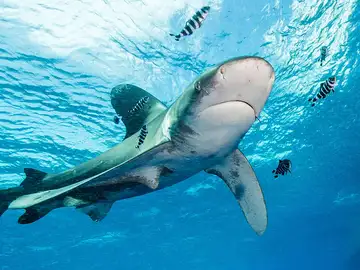
A large shark of warm open oceans, easily told by its rounded fins with white tips. It cruises slowly and is often escorted by striped pilot fish. Adults are usually about 3 m long.
See it on the 3D globe →At a glance
- Class
- Fish
- Lives in
- Warm tropical and subtropical open seas, e.g. the northern Red Sea
- Diet
- Fish eater
- Conservation status
- Critically Endangered (IUCN CR)
- Habitat
- open ocean
Quick answers
Where does the Oceanic whitetip shark live?
It lives in the open ocean of the Pacific, Atlantic and Indian oceans. On the globe you can find it near Warm tropical and subtropical open seas, e.g. the northern Red Sea.
What does the Oceanic whitetip shark eat?
Its diet: fish eater.
Is the Oceanic whitetip shark endangered?
It is listed as Critically Endangered (IUCN CR).
The oceanic whitetip shark (Carcharhinus longimanus) is a large shark of warm, deep, open water. It is easy to recognise because its long, rounded fins have bright white tips. Adults are usually about 3 metres long, with a stocky body, and they often swim slowly near the surface.
It lives in tropical and warm temperate seas almost all around the world, far from the coast. It usually travels alone, but several can gather where there is lots of food. Sadly it is now listed as critically endangered, mostly because so many are caught for their fins and meat. Protecting open-ocean sharks is hard, because they roam across the borders of many countries.
Where it lives
Oceanic whitetips are found worldwide between about 45 degrees north and 43 degrees south. They like deep, open ocean where the water is warmer than about 18 degrees Celsius, and they prefer water above 20 degrees. Most of their time is spent in the top 150 metres. The farther from land you go, the more of them there tend to be. Scientists think their numbers have dropped steeply, even though they were once among the most common sharks in the sea.
Food and family
This shark eats mainly bony fish and squid. It cruises slowly but is bold and opportunistic, meaning it will investigate almost any chance of a meal. Its old nickname, the shipwreck shark, comes from stories of it circling survivors of sunken ships. Mothers give birth to live young rather than laying eggs. Researchers say this species often turns up in places where fishing boats work, which adds to the risk. Fishing pressure is rising across its whole range.
Fun facts
- It has long, rounded, white-tipped fins and roams the open ocean far from land.
- Its scientific name longimanus means 'long hands' in Latin, because of its big pectoral fins.
- Tiny fossil teeth from this kind of shark have been found in India, from the Early Miocene, many millions of years ago.
- It is also called the shipwreck shark, because of old tales about sharks near sunken ships.
On the globe
The model shows the shark with its rounded, white-tipped fins in the warm open sea, here near the northern Red Sea. Look for the pale fin tips.
More like this

Sources
Updated: 2026-10-14