
Brown pelican
브라운펠리컨
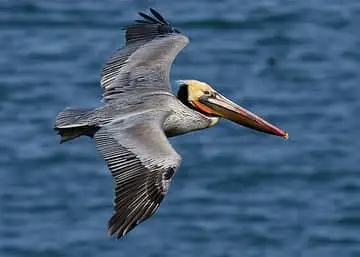
The smallest pelican, yet the only one that plunge-dives headfirst from the air to catch fish. It scoops fish and water into its big throat pouch, drains the water out, and then swallows the fish.
See it on the 3D globe →At a glance
- Class
- Birds
- Diet
- Fish eater
- Weight
- about 3.7 kg
- Length
- about 1.2 m
- Top speed
- about 48 km/h
- Lifespan
- up to about 31 years
- Conservation status
- Least Concern (IUCN LC)
- Habitat
- coasts
Quick answers
Where does the Brown pelican live?
It lives in coasts of the Atlantic and Pacific oceans.
How big is the Brown pelican?
It grows to about 1.2 m and 3.7 kg.
What does the Brown pelican eat?
Its diet: fish eater.
How fast is the Brown pelican?
It can reach about 48 km/h.
How long does the Brown pelican live?
It can live up to about 31 years.
Is the Brown pelican endangered?
It is listed as Least Concern (IUCN LC).
The brown pelican (Pelecanus occidentalis) is the smallest of the pelicans, but it is the only one that regularly dives headfirst from the air to catch fish. It scoops fish and water into a big stretchy throat pouch, then drains the water out before it swallows.
It lives on coasts in the Americas, along the Atlantic from New Jersey to the mouth of the Amazon and along the Pacific from British Columbia to Peru, including the Galapagos Islands. Adults are about 1.2 metres long with a wingspan of around 2 metres. In breeding season the head is white with a yellowish crown and the neck is dark maroon-brown.
A comeback story
In the 20th century, farm chemicals such as DDT and dieldrin made the eggshells of pelicans too weak, and the bird nearly disappeared from parts of the United States. The brown pelican was listed as endangered there from 1970 to 2009. After DDT was banned, in Florida in 1972 and then across the country, its numbers grew again. Today the IUCN rates it as Least Concern.
Nests and chicks
Brown pelicans nest in colonies in quiet places such as islands, mangroves and sand dunes. The female lays two or three chalky white eggs, and both parents take turns sitting on them for 28 to 30 days. Newly hatched chicks are pink and turn grey or black within a couple of weeks. After about 63 days they can fly, and young birds then gather in small groups called pods.
Fun facts
- It is one of only two pelicans that dive head-first from the air to catch fish.
- It is the state bird of Louisiana and the national bird of Barbados.
- In 1903 President Theodore Roosevelt made Florida's Pelican Island the first National Wildlife Refuge to protect these birds.
- Young pelicans that have left the nest gather in groups called pods.
On the globe
The model shows a brown pelican on a coast. Look for its large throat pouch and its brown plumage.
Quiz time
Which is heavier: Brown pelican or Greater roadrunner?
Show the answer
Brown pelican. (3.7 kg vs 0.38 kg) Greater roadrunner →
More like this
.jpg)
Sources
Updated: 2026-10-14