
Greater roadrunner
로드러너
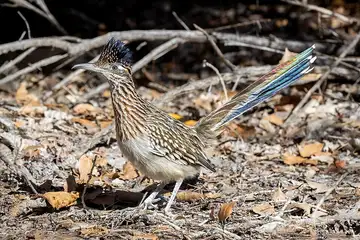
A ground-dwelling cuckoo of the southwestern North American deserts that prefers running to flying. Streaked and long-tailed, it can sprint at about 30 km/h. It eats lizards, snakes and insects.
See it on the 3D globe →At a glance
- Class
- Birds
- Lives in
- Deserts of the southwestern US and northern Mexico
- Diet
- Meat eater (carnivore)
- Weight
- about 0.38 kg
- Length
- about 0.56 m
- Top speed
- about 32 km/h
- Conservation status
- Least Concern (IUCN LC)
- Habitat
- deserts
Quick answers
Where does the Greater roadrunner live?
It lives in deserts. On the globe you can find it near Deserts of the southwestern US and northern Mexico.
How big is the Greater roadrunner?
It grows to about 0.56 m and 0.38 kg.
What does the Greater roadrunner eat?
Its diet: meat eater (carnivore).
How fast is the Greater roadrunner?
It can reach about 32 km/h.
Is the Greater roadrunner endangered?
It is listed as Least Concern (IUCN LC).
The greater roadrunner is a long-legged bird that lives in the deserts and scrublands of the south-western United States and Mexico. It is the largest cuckoo in the Americas, about 52 to 62 centimetres long, with a long tail, a shaggy crest on its head and streaky brown and white feathers. Behind each eye it has a bare patch of orange and blue skin.
Although it can fly a little, the roadrunner spends most of its time on the ground and runs instead. It can reach about 32 kilometres per hour, and some have been reported at 42, which is the fastest running speed recorded for a flying bird. It hunts lizards, snakes and insects. The globe places it in the deserts of the south-western United States and northern Mexico.
Built to run
The roadrunner weighs only about 220 to 540 grams and stands about 25 to 30 centimetres tall. Like other cuckoos it has zygodactyl feet, with two toes pointing forward and two pointing backward, which leave a distinctive track. Males and females look the same, though females are slightly smaller. Its scientific name means Californian earth-cuckoo, and old names include chaparral cock, ground cuckoo and snake killer.
From forest to desert
Fossils show that roadrunners have lived in the south-west for tens of thousands of years, including in the La Brea Tar Pits in California. Until about 8,000 years ago, they lived in sparse forests rather than dry scrub, and only later adapted to deserts. Today the species is slowly spreading north-east, as people change the landscape. Males make a slow, descending series of low cooing calls that can be heard from 250 metres away.
Fun facts
- This cuckoo prefers running to flying and can even catch and eat rattlesnakes.
- The roadrunner is the fastest-running flying bird known, with reports up to 42 kilometres per hour.
- It can catch and eat rattlesnakes.
- Its feet have two toes forward and two backward, a pattern called zygodactyl.
On the globe
The globe places the roadrunner in the deserts of the south-western US and northern Mexico. Look for the long tail and the shaggy crest.
Quiz time
Which is heavier: Greater roadrunner or Brown pelican?
Show the answer
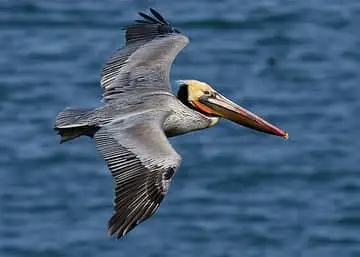
Brown pelican. (0.38 kg vs 3.7 kg) Brown pelican →
More like this




Sources
Updated: 2026-10-14