
Chamois
발칸샤무아
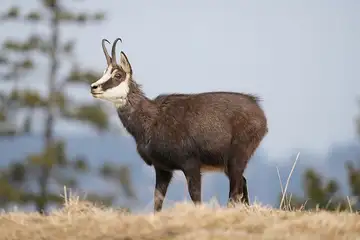
The chamois is a small goat-antelope of the mountains of Europe and southwest Asia. It has a dark stripe under each eye and short horns that hook sharply backward. It climbs steep rocky slopes with ease and lives in herds; its coat turns dark brown in winter.
See it on the 3D globe →At a glance
- Class
- Mammals
- Lives in
- Balkan and other European mountains
- Diet
- Plant eater (herbivore)
- Weight
- about 40 kg
- Conservation status
- Least Concern (IUCN LC)
- Habitat
- mountains
Quick answers
Where does the Chamois live?
It lives in mountains. On the globe you can find it near Balkan and other European mountains.
How big is the Chamois?
It grows to about 40 kg.
What does the Chamois eat?
Its diet: plant eater (herbivore).
Is the Chamois endangered?
It is listed as Least Concern (IUCN LC).
The chamois is a small goat-antelope of the mountains of Europe and western Asia. It lives from the Pyrenees, the Alps and the Apennines to the Balkans, the Carpathians, northeastern Turkey and the Caucasus, and it has also been introduced to New Zealand's South Island. Some subspecies are strictly protected in the EU under the Habitats Directive.
It is a very small bovid, about 70 to 80 cm tall. Males weigh 30 to 60 kg and females 25 to 45 kg. Both have short, nearly straight horns that hook backward near the tip, and the male's are thicker. The summer coat is rich brown and turns light grey in winter. Clear white marks on the sides of the head, black stripes below the eyes, a white rump and a black stripe along the back make it easy to recognise.
Life on the rocks
The chamois lives on steep, rugged, rocky ground up to at least 3,600 metres. In Europe it spends summer in alpine meadows above the tree line and moves down to about 800 metres in winter, into pine forests. It eats grasses and herbs in summer and conifer needles and bark in winter. It escapes danger with speed and stealth, running at 50 km/h and jumping 2 metres straight up or 6 metres across.
Herds, kids and old age
Females and their young live in herds of 15 to 30, while adult males mostly live alone. In the autumn rut the males fight fiercely for mates. After about 170 days of pregnancy a single kid is usually born in May or early June, and sometimes other females in the herd will raise a kid whose mother has died. Chamois can live to 22 years in captivity, but in the wild the average is 15 to 17 years. Avalanches, disease and predators are common dangers.
Chamois and people
The chamois has been hunted for its meat, and hunters use its habits against it, since it watches for danger from below. The tuft of hair from the back of its neck, the gamsbart, is traditionally worn on hats in the Alpine countries. Soft chamois leather, once made from its hide, is smooth and absorbent and does not scratch, so it was prized for polishing and cleaning. Chamois reached New Zealand in 1907 as a gift from the Austrian Emperor.
Fun facts
- Soft "shammy" cleaning leather is named after the chamois, whose hide was first used for it.
- It can jump 2 metres straight up.
- The word for soft 'shammy' cleaning leather comes from this animal.
- Its horns hook backward at the tip.
- A gift of chamois from the Austrian Emperor reached New Zealand in 1907.
On the globe
The model shows a mountain goat-antelope with dark eye stripes and hooked horns, as in the card. Look for the stripe under each eye.
Quiz time
Which is heavier: Chamois or Golden jackal?
Show the answer
Chamois. (40 kg vs 10 kg) Golden jackal →
More like this



Sources
Updated: 2026-10-14