
Mediterranean monk seal
지중해몽크물범
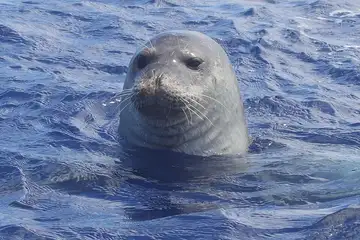
The Mediterranean monk seal is a dark brown seal with a pale patch on its belly, and one of the rarest seals in the world. Only about 800 are thought to survive, mostly in the Aegean Sea and around Madeira.
See it on the 3D globe →At a glance
- Class
- Mammals
- Lives in
- Aegean Sea and eastern Mediterranean
- Diet
- Fish eater
- Weight
- about 270 kg
- Length
- about 2.5 m
- Conservation status
- Vulnerable (IUCN VU)
- Habitat
- coasts, caves
Quick answers
Where does the Mediterranean monk seal live?
It lives in coasts, caves of the Atlantic Ocean. On the globe you can find it near Aegean Sea and eastern Mediterranean.
How big is the Mediterranean monk seal?
It grows to about 2.5 m and 270 kg.
What does the Mediterranean monk seal eat?
Its diet: fish eater.
Is the Mediterranean monk seal endangered?
It is listed as Vulnerable (IUCN VU).
The Mediterranean monk seal is one of the rarest seals in the world. Estimates say that only about 800 to 1,000 survive, in isolated groups in the Mediterranean (especially the Aegean Sea), around the island group of Madeira and near Cabo Blanco on the border of Mauritania and Western Sahara.
It is a big, dark brown seal with a pale patch on its belly. It is also listed as Vulnerable, so careful protection of its quiet beaches and sea caves keeps it from slipping toward extinction. It is the only living species in the genus Monachus. Today the remaining animals live in small, isolated groups.
What does it look like?
Adults average about 2.4 metres long and can weigh 240 to 400 kilograms. Males are black and females brown to dark grey, with a paler belly. The belly patch is butterfly-shaped in males and usually rectangular in females. The snout is short, broad and flat. Monk seals may live up to 45 years, but 20 to 25 is more typical. Males are around 320 kilograms on average and females about 300, and they feed on fish in coastal waters. They reach adulthood at about age four.
Pups and hiding places
Mothers usually give birth in hard-to-reach underwater caves. Records show they used open beaches until the 1700s, before people pushed them into hiding. A pup is about one metre long, weighs 15 to 18 kilograms, and has dark brown or black fur that is replaced after six to eight weeks. Because pups are born in sheltered caves, quiet coasts and protected sea caves are very important for the seal's future.
Fun facts
- One of the rarest seals, with fewer than 1,000 left; mothers often give birth in sea caves.
- It is thought to be the rarest seal-type animal (pinniped) in the world.
- Its short hair may be the shortest of any pinniped.
- Mothers often give birth in sea caves, not on beaches.
On the globe
The model shows a Mediterranean monk seal, dark brown with a pale belly patch, resting by the sea.
Quiz time
Which is heavier: Mediterranean monk seal or Chamois?
Show the answer
Mediterranean monk seal. (270 kg vs 40 kg) Chamois →
More like this




Sources
Updated: 2026-10-14