
European wildcat
유럽살쾡이
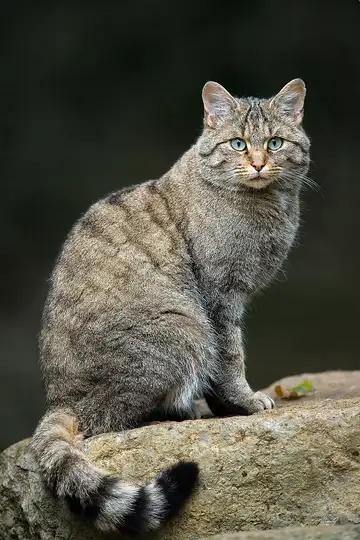
The European wildcat is stockier than a house cat, with bold tabby stripes and a thick, blunt tail ringed in black. It lives alone in old forests and hunts mostly mice and voles. It is a separate species from the domestic cat, though the two can interbreed.
See it on the 3D globe →At a glance
- Class
- Mammals
- Lives in
- Carpathian and other European forests
- Diet
- Meat eater (carnivore)
- Weight
- about 5 kg
- Length
- about 0.9 m
- Conservation status
- Least Concern (IUCN LC)
- Habitat
- forests
Quick answers
Where does the European wildcat live?
It lives in forests. On the globe you can find it near Carpathian and other European forests.
How big is the European wildcat?
It grows to about 0.9 m and 5 kg.
What does the European wildcat eat?
Its diet: meat eater (carnivore).
Is the European wildcat endangered?
It is listed as Least Concern (IUCN LC).
The European wildcat is a small wild cat that looks a lot like a stocky tabby but is a separate wild species, Felis silvestris. Its fur is brownish to grey with stripes on the forehead and sides, and its bushy tail has two or three black rings and a blunt black tip. Head and body can be up to 65 cm long, with a tail of about 34.5 cm, and the cat weighs up to 7.5 kg.
It is native to continental Europe, Scotland and Turkey and the Caucasus, and lives mainly in broad-leaved and mixed forests. In France and Italy it is mostly nocturnal, but it also hunts by day where people leave it undisturbed. It feeds mostly on small mammals such as rabbits, hares and rodents, as well as ground-living birds. Two subspecies are recognised as valid: one in continental Europe, Scotland and Sicily, and another in Turkey and the Caucasus.
Spotting a wildcat
Its fur is brownish to grey. It has five stripes on the forehead, often broken into small spots, and a dark stripe that runs from the shoulders along the spine to the tail. The side stripes are irregular and break into blotches on the hind legs. The tail is thick and rounded at the tip, which is black. The guard hairs are about 7 cm long, with underfur of 11 to 14 cm.
What it eats
Diets change from place to place. In Western Europe it eats hamsters, brown rats, dormice and voles. In the Carpathians it hunts mostly mice and voles and sometimes hares, while in swamps in eastern Europe it takes water voles, rats, muskrats and waterfowl. Sometimes it takes small carnivores such as martens, stoats and weasels, or the fawns of roe deer and chamois. In summer in Moldova it also eats birds, fish and crayfish.
Dangers and protection
European wildcats have become rare in most European countries. They are protected by law, but some are still shot by people who mistake them for feral cats. In the Scottish Highlands about 400 were thought to remain in 2004, and breeding with feral cats is a threat to what makes the wildcat distinct. Germany has a project, begun in 2004, to link forests with strips of bushes and trees, and a map of 20,000 km of wildcat corridors. The species is protected by CITES, the Berne Convention and the EU Habitats Directive.
Fun facts
- It looks like a stocky tabby cat but has a thick, ringed tail with a blunt black tip.
- It looks like a tabby cat but has a thick tail with a blunt black tip.
- A wildcat photographed in Sicily in 2009 and again in 2018 was probably at least 10 years old.
- Some are shot by mistake for stray cats.
- A German project plans 20,000 km of forest corridors for wildcats.
On the globe
The model shows a stocky striped wildcat with a bushy ringed tail, as in the card. Look at the thick tail with its black tip.
Quiz time
Which is heavier: European wildcat or Golden jackal?
Show the answer
Golden jackal. (5 kg vs 10 kg) Golden jackal →
More like this



Sources
Updated: 2026-10-14