
Deathstalker
데스스토커전갈
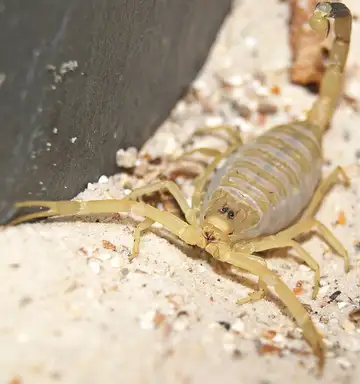
A pale yellow desert scorpion of the Middle East and North Africa, only about 8 to 10 cm long. Its pincers are slender, but its venom is among the most potent of any scorpion. It hunts insects at night.
See it on the 3D globe →At a glance
- Class
- Spiders & scorpions
- Lives in
- Deserts of the Middle East and North Africa
- Diet
- Insect eater
- Length
- about 0.06 m
- Habitat
- deserts
Quick answers
Where does the Deathstalker live?
It lives in deserts. On the globe you can find it near Deserts of the Middle East and North Africa.
How big is the Deathstalker?
It grows to about 0.06 m.
What does the Deathstalker eat?
Its diet: insect eater.
The deathstalker (Leiurus quinquestriatus) is a pale yellow desert scorpion of North Africa and the Middle East. It is also known as the Palestine yellow scorpion, the Omdurman scorpion or the Naqab desert scorpion. It is small, only 30 to 77 millimetres long, with an average of 58 millimetres, and it has slender pincers.
The name sounds scary because its venom is one of the most potent of any scorpion. A sting is extremely painful, but it normally would not kill a healthy adult. Young children, elderly people and people who are ill or allergic are at greater risk. Its range stretches from Algeria and Mali to Egypt, the Arabian Peninsula and Kazakhstan.
Life in the desert
The deathstalker lives in deserts and scrubland from the Sahara and the Arabian Desert to the Thar Desert and Central Asia. It is nocturnal and hunts insects at night. Its scientific name translates roughly as 'five-striped smooth-tail'. In 2014 one subspecies was separated into its own species, Leiurus hebraeus. Other scorpions of the genus are sometimes called deathstalkers too, so scientists prefer the Latin name.
Venom that helps science
The venom is a mix of neurotoxins, with names such as chlorotoxin, charybdotoxin and scyllatoxin. A protein from this venom, chlorotoxin, is used in research to light up brain tumours. A sting that does become deadly usually causes death through fluid in the lungs. An antivenom for deathstalker stings is made, and anyone stung should get medical help quickly. Doctors have also seen pancreatitis after stings in one study from Israel.
Fun facts
- One of the most dangerous scorpions, yet a protein from its venom is used in research to light up brain tumours.
- Its name means roughly 'five-striped smooth-tail'.
- It is only about 58 millimetres long on average.
- A protein from its venom is used to light up brain tumours in research.
- Its range runs from Algeria and Mali to Kazakhstan.
On the globe
The model stands in the desert lands of the Arabian Peninsula and North Africa. Look for the pale yellow body and slim claws.
More like this

Sources
Updated: 2026-10-14