
Goliath birdeater
골리앗버드이터
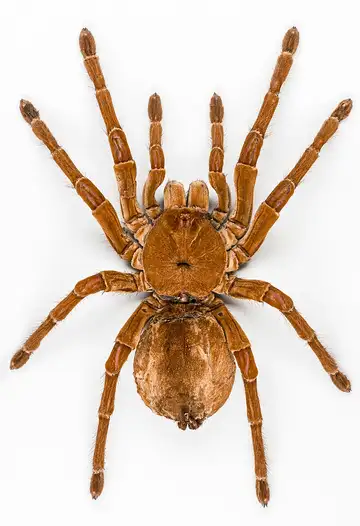
The Goliath birdeater is the heaviest spider in the world, with a leg span of about 30 cm. It lives in burrows, hunts worms and frogs at night, and flicks irritating hairs from its abdomen when threatened.
See it on the 3D globe →At a glance
- Class
- Spiders & scorpions
- Lives in
- Rainforests of Venezuela, Guyana and northern Brazil
- Diet
- Meat eater (carnivore)
- Length
- about 0.12 m
- Lifespan
- up to about 25 years
- Habitat
- rainforests
Quick answers
Where does the Goliath birdeater live?
It lives in rainforests. On the globe you can find it near Rainforests of Venezuela, Guyana and northern Brazil.
How big is the Goliath birdeater?
It grows to about 0.12 m.
What does the Goliath birdeater eat?
Its diet: meat eater (carnivore).
How long does the Goliath birdeater live?
It can live up to about 25 years.
The Goliath birdeater is a giant tarantula of northern South America. It is the largest spider in the world by weight, up to about 175 grams, and by body length, up to 13 centimetres. Only the giant huntsman spider beats it in leg span, and the birdeater's legs can stretch about 30 centimetres.
Its name is a little misleading. People started calling tarantulas bird-eating after an 18th-century engraving by Maria Sibylla Merian showed one eating a hummingbird, but this spider rarely hunts birds. It mostly eats insects, worms and frogs. Unlike some tarantulas, it lives in a burrow and comes out mostly at night.
How does it defend itself?
When threatened, a Goliath birdeater rubs its back legs against its belly and flicks tiny hairs into the air. These hairs irritate skin and the inside of the nose and mouth. It can also make a rasping sound by rubbing hairs on its legs. Its fangs are 2 to 4 centimetres long, but the venom is comparable to a wasp sting. A tarantula's bite is rarely a danger to people, but its irritating hairs can hurt. They are best left alone, and are observed from a safe distance.
Growing up
A female lays 100 to 200 eggs, which hatch into spiderlings after six to eight weeks. Females mature in three to six years and live 15 to 25 years on average. Males live only three to six years, and, unlike in some spiders, the female rarely eats the male. The spiderlings stay near the burrow before they spread out. Spiderlings leave the nest after they hatch.
Fun facts
- Despite its name it rarely eats birds; it mostly eats insects, worms and frogs.
- It is the largest spider by mass, at up to about 175 grams.
- Its fangs can be 2 to 4 centimetres long.
- Despite the name, it rarely eats birds.
On the globe
The model shows a big hairy tarantula. Look for it in the forests of northern South America.
More like this

Sources
Updated: 2026-10-14