
Emperor penguin
황제펭귄
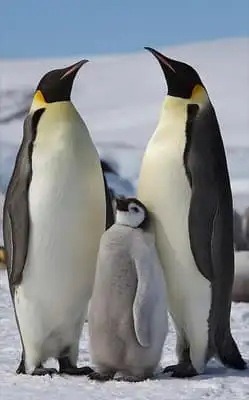
The largest penguin, about 1.1 m tall; through the -40 °C Antarctic winter the males keep the egg warm on their feet. They go without food for around two months, huddling together against the cold.
See it on the 3D globe →At a glance
- Class
- Birds
- Lives in
- Antarctic coast
- Diet
- Fish eater
- Weight
- about 33 kg
- Length
- about 1.15 m
- Top speed
- about 19 km/h
- Lifespan
- up to about 20 years
- Conservation status
- Near Threatened (IUCN NT)
- Habitat
- polar regions, coasts
Quick answers
Where does the Emperor penguin live?
It lives in polar regions, coasts of the Southern Ocean. On the globe you can find it near Antarctic coast.
How big is the Emperor penguin?
It grows to about 1.15 m and 33 kg.
What does the Emperor penguin eat?
Its diet: fish eater.
How fast is the Emperor penguin?
It can reach about 19 km/h.
How long does the Emperor penguin live?
It can live up to about 20 years.
Is the Emperor penguin endangered?
It is listed as Near Threatened (IUCN NT).
The emperor penguin is the tallest and heaviest of all penguins. An average adult stands about 114 centimetres (45 inches) tall and weighs between about 22 and 45 kilograms. It lives only in Antarctica, on the sea ice around the coast and in the icy ocean nearby. Emperor penguins cannot fly, but they are superb swimmers and divers.
Emperor penguins are famous for raising their chicks during the Antarctic winter, the coldest conditions any bird breeds in, with air temperatures as low as -40 °C and winds up to 144 km/h. The IUCN moved them from Least Concern to Near Threatened in 2012. Scientists worry that climate change will shrink the sea ice they need for raising chicks, and fishing and warming seas could reduce their food.
Family life
At the start of the Antarctic winter, in March and April, emperor penguins walk 50 to 120 kilometres across the ice to their breeding colonies. Each female lays a single egg, passes it to her mate and heads back to sea to feed. The male balances the egg on his feet and covers it with a warm fold of feathered skin called a brood pouch. For just over two months, through the dark winter, he eats nothing and loses around 12 kilograms. When the chick hatches, the mother returns with a belly full of food to feed it, and the hungry father finally goes to sea.
Surviving the cold
To stay warm, emperor penguins crowd into a tight huddle of tens to hundreds of birds, each leaning on its neighbours. The middle is the warmest spot, so birds on the windy edge slowly shuffle around to the sheltered side. This creates a slow churning movement that gives every penguin a turn in the middle. Thick layers of feathers and fat also protect them. Outside its parent's brood pouch, a young chick could freeze in just a few minutes.
Amazing diver
Emperor penguins hunt fish, squid and krill in the cold Southern Ocean. They are the deepest-diving birds known: in 1994 one penguin reached 564 metres, and its dive lasted almost 22 minutes. Their bones are solid rather than filled with air, which helps them cope with the crushing water pressure deep down. Parents feeding a chick may travel up to 500 kilometres from the colony to find food.
Fun facts
- Males keep the egg warm on their feet through the dark Antarctic winter for about two months.
- Male emperor penguins keep the egg warm on their feet for about two months without eating.
- An emperor penguin once dived to 564 metres, deeper than any other bird on record.
- Huddling penguins take turns standing in the warm middle of the group.
- Emperor penguins breed in the coldest environment of any bird on Earth.
- Its scientific name Aptenodytes comes from Ancient Greek words meaning 'wingless diver'.
On the globe
The model shows emperor penguins on the coast of Antarctica. Look for the tall penguins standing together on the ice.
Quiz time
Which is heavier: Emperor penguin or Adélie penguin?
Show the answer
Emperor penguin. (33 kg vs 4.8 kg) Adélie penguin →
More like this

Sources
Updated: 2026-10-13