
European eel
유럽뱀장어
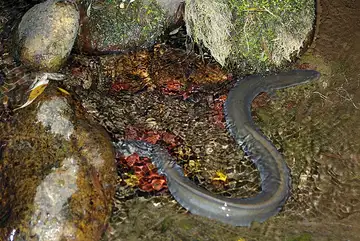
The European eel is a snake-like fish with an olive body and one continuous fin running along its back, tail and belly. It grows up in rivers and lakes, then is thought to swim about 5,000 km to spawn in the Sargasso Sea.
See it on the 3D globe →At a glance
- Class
- Fish
- Lives in
- Sargasso Sea (spawning), European rivers and coasts
- Diet
- Meat eater (carnivore)
- Length
- about 0.7 m
- Conservation status
- Critically Endangered (IUCN CR)
- Habitat
- rivers & lakes, coasts, open ocean
Quick answers
Where does the European eel live?
It lives in rivers & lakes, coasts, open ocean of the Atlantic Ocean. On the globe you can find it near Sargasso Sea (spawning), European rivers and coasts.
How big is the European eel?
It grows to about 0.7 m.
What does the European eel eat?
Its diet: meat eater (carnivore).
Is the European eel endangered?
It is listed as Critically Endangered (IUCN CR).
The European eel is a snake-like fish with one of the strangest life stories in nature. For thousands of years nobody knew where eels came from, and mating in the wild has still never been observed. They are thought to spawn in the Sargasso Sea, then the larvae drift north across the Atlantic to the coasts and rivers of Europe and North Africa. The five stages of their life were once thought to be different species.
The stages are the leaf-shaped larva (leptocephalus), the glass eel, the elver, the yellow eel and the silver eel. Adults in the yellow stage are usually 45 to 65 cm long, rarely more than 1 metre, but a few reach 1.33 metres. They live about 15 to 20 years in the wild. The European eel is critically endangered. The number of young eels reaching Europe is thought to have fallen by around 90 percent, possibly 98 percent, since the 1970s.
A very long journey
After spawning in the Sargasso Sea, young eels spread north across the Atlantic, its coasts and the rivers that run into it. They live from the surface to depths of about 700 metres. An eel spends most of its life feeding in fresh or coastal water, mostly at night, and finds food by scent. Prey include worms, fish, snails and crayfish. Eels hide in plants, in tube-shaped gaps in rocks, or in mud. Herons, cormorants, pike and larger eels eat them.
Why are they disappearing?
The causes include overfishing, a parasitic worm called Anguillicola crassus, and barriers such as hydroelectric dams, which block migration. Over an 80-year period, waters with large dams lost almost twice as many eels as dam-free waters. Natural changes in ocean currents such as the Gulf Stream may also play a part, and pollution with chemicals called PCBs may be involved. The eel is listed in Appendix II of CITES, and the TRAFFIC programme works to make eel trade traceable and legal.
Trying to breed eels
Scientists have tried for years to breed eels in captivity. In 1997 a Dutch team built a swimming machine to imitate the 6,500 km journey to the Sargasso Sea. In 2006 DTU Aqua in Denmark managed to breed them using fresh and salt water and hormones, and the larvae survived 4.5 days. By 2007 they survived 12 days. Studies in the Sargasso Sea suggest the larvae eat many kinds of plankton, especially tiny jellyfish. The record for the oldest eel is the Brantevik Eel in Sweden, said to have lived 155 years in a well.
Fun facts
- European eels are thought to hatch in the Sargasso Sea and drift thousands of kilometres to Europe as larvae.
- Mating in the wild has never been seen.
- An eel in a Swedish well is said to have lived 155 years.
- It is thought to be born in the Sargasso Sea and to travel to Europe as a larva.
- The five life stages were once believed to be different species.
On the globe
The model shows a long, snake-like eel, as in the card. Look at the long body and the fin along its back and belly.
Quiz time
Which is longer: European eel or Sargassum fish?
Show the answer
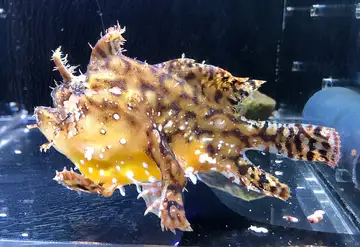
European eel. (0.7 m vs 0.15 m) Sargassum fish →
More like this

Sources
Updated: 2026-10-14