
Parrotfish
비늘돔 떼
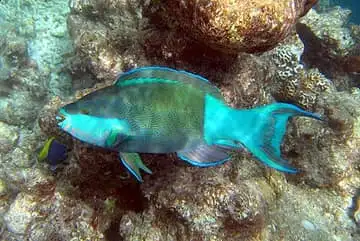
A colourful reef fish with hard, beak-like teeth that scrape algae off coral. It poops out ground-up coral as fine sand, helping make white tropical beaches, and some species sleep inside a bubble of mucus.
See it on the 3D globe →At a glance
- Class
- Fish
- Diet
- Plant eater (herbivore)
- Habitat
- coral reefs
Quick answers
Where does the Parrotfish live?
It lives in coral reefs of the Pacific, Atlantic and Indian oceans.
What does the Parrotfish eat?
Its diet: plant eater (herbivore).
Parrotfish are colourful fish of coral reefs, rocky coasts and seagrass beds. They get their name because their mouths look like a parrot's beak. There are about 95 species, and the most kinds live in the Indo-Pacific. Most grow 30 to 50 centimetres long, but the green humphead parrotfish can reach 1.3 metres.
Their many teeth are packed together on the outside of their jaw bones, forming a hard beak that scrapes algae off coral and rocks. This feeding wears away the reef and turns it into sand, which helps to make sandy sea floors and beaches. The group is placed in the wrasse family.
Making sand
Parrotfish are herbivores or coral-eaters. As they scrape the reef for algae, they also grind up bits of hard coral. These bits pass through their bodies and come out as fine sand. Scientists call the wearing away of coral bioerosion, and parrotfish play a big part in it. In this way a fish that eats algae also builds sandy sea floors and beaches.
Sleeping in a bubble
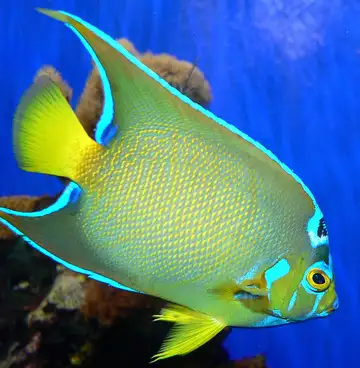
Some parrotfish, such as the queen parrotfish, make a mucus covering around themselves at night. This covering can help protect them while they sleep. The smallest parrotfish, the bluelip parrotfish, is only about 13 centimetres long. Scientists used to treat parrotfish as their own family, but genetic studies show they are a group deep within the wrasse family. Fossils of parrotfish teeth and bones are known from the Miocene.
Fun facts
- Parrotfish grind up coral as they feed and pass it out as fine sand, helping to build tropical beaches.
- Parrotfish are named after a parrot's beak.
- The biggest parrotfish can reach about 1.3 metres.
- Scientists now treat parrotfish as a special group inside the wrasse family.
On the globe
The model shows a colourful parrotfish. Look for its beak-like mouth and bright colours.
More like this

Sources
Updated: 2026-10-14