
Giant barrel sponge
통해면
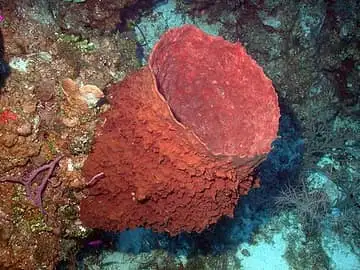
A barrel-shaped sponge standing on Caribbean reefs, large enough in some cases for a diver to fit inside. It filters seawater for food, and grows so slowly that some individuals live for more than a century.
See it on the 3D globe →At a glance
- Class
- Sponges
- Diet
- Filter feeder
- Habitat
- coral reefs
Quick answers
Where does the Giant barrel sponge live?
It lives in coral reefs of the Atlantic Ocean.
What does the Giant barrel sponge eat?
Its diet: filter feeder.
The giant barrel sponge (Xestospongia muta) is the largest sponge found on Caribbean coral reefs. It is common at depths from about 10 to 120 metres and can reach 1.8 metres across. It is usually brownish-red to brownish-grey, with a hard, stony feel, and it lives on reefs around the Caribbean, the Bahamas, Bermuda, Florida and the Gulf of Mexico.
Because of its huge size and very long life, which may exceed 2,000 years, it is called the redwood of the reef. It is probably the best-studied sponge in the sea; a group on Conch Reef in the Florida Keys has been monitored since 1997. In shape it is typically a barrel with a cone-shaped cavity at the top, called the osculum, but some are low and squat or tall and thin.
A living filter
The sponge is a filter feeder. Water is pumped in through small pores in its sides, through channels lined with cells that have beating whip-like tails, and out of the osculum at the top. Tiny bacteria are caught as the water passes, and the sponge also absorbs dissolved food straight from seawater. Off the Florida Keys it can be as common as two per square metre, and its total mass is greater than any other bottom-living invertebrate there.
Age and growth
Sponges photographed over 4.5 years grew at very different rates, from more than 400 percent a year to only 2 percent. The largest sponges on Conch Reef, about the size of an oil barrel, were estimated to be about 130 years old. The largest one with a photo, now dead, was estimated at 2,300 years. Scientists can estimate age from the width of the osculum and the base circumference.
Colour and reef life
Its colour comes from cyanobacteria living in its tissues. Sometimes the sponge bleaches pale, but this happens in cycles and it recovers. Unlike corals, it does not seem to depend on these partners for food. The sponge is home to many small animals and microbes, and some parrotfish graze on it. A disease called sponge orange band can kill it, and the cause and spread remain a mystery.
Fun facts
- The largest ones are big enough for a diver to fit inside, and they can live for centuries.
- It is called the redwood of the reef.
- The largest ones may be over 2,000 years old.
- It can reach 1.8 metres across.
- It sometimes turns white and then recovers its colour.
On the globe
The model shows a large, rough, barrel-shaped sponge with an opening on top, as in the card. Look at the hole at the top.
More like this

Sources
Updated: 2026-10-14