
Tube sponge & black coral
관해면·흑산호
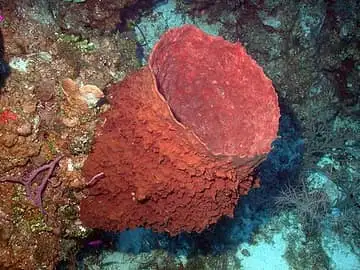
A sponge shaped like tall tubes. It is an animal with no brain, muscles or organs, yet it filters huge amounts of water to catch tiny food. Black corals grow beside it so slowly that some live for thousands of years.
See it on the 3D globe →At a glance
- Class
- Sponges
- Diet
- Filter feeder
- Habitat
- coral reefs
Quick answers
Where does the Tube sponge & black coral live?
It lives in coral reefs of the Atlantic Ocean.
What does the Tube sponge & black coral eat?
Its diet: filter feeder.
A tube sponge is an animal shaped like a tall, hollow tube standing on the seabed. It belongs to the sponges, a group called Porifera, a name that means pore-bearing. A sponge has no brain, no muscles and no real organs, and it stays fixed in one place all its life.
Instead of hunting, it pumps seawater through the tiny pores and channels in its body and filters out little bits of food and oxygen. Tube sponges are common neighbours of corals, including slow-growing black corals, on reefs of the Atlantic Ocean. Sponges are so simple that they have no true tissues or organs, yet they have survived for hundreds of millions of years.
How does a sponge eat without a mouth or stomach?
A sponge's body is full of pores and canals. Special cells with tiny whip-like hairs beat to keep water flowing in through the walls and out through the opening at the top. Food particles and oxygen are taken from the water, and waste is carried away with it.
Because the water does all the work, a sponge does not need the nervous, digestive or circulatory systems that most animals have. Scientists think sponges are among the oldest animals alive; fossils that look like simple sponges are about 800 million years old.
Who lives next door?
Tube sponges often grow on coral reefs. Reefs cover less than one percent of the ocean floor, yet they shelter at least a quarter of all marine species, and sponges are one of the groups that live there.
Black corals are close neighbours. They have a dark, horn-like skeleton covered by coloured polyps, and some grow so slowly that they can live for thousands of years. Poaching for jewellery, ocean acidification and climate change are shrinking their numbers.
Fun facts
- Sponges have no brain or organs, and some black corals that grow beside them are over 4,000 years old.
- A sponge is an animal even though it has no brain, muscles or organs.
- Fossils that look like simple sponges are about 800 million years old.
- Coral reefs cover less than 0.1 percent of the ocean but are home to at least a quarter of marine species.
On the globe
The model shows tall tube-shaped sponges standing on the seabed, with black corals growing beside them.
More like this

Sources
Updated: 2026-10-14