
Harp seal
하프물범
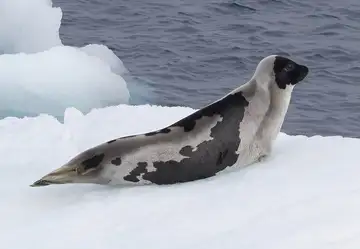
Adults are silver-grey with a black head and a harp-shaped black mark on the back, while pups wear a white coat for their first weeks. They migrate thousands of kilometres across the North Atlantic and Arctic and breed on the ice in spring.
See it on the 3D globe →At a glance
- Class
- Mammals
- Lives in
- North Atlantic & Arctic, Gulf of St. Lawrence
- Diet
- Fish eater
- Weight
- about 130 kg
- Length
- about 1.8 m
- Conservation status
- Near Threatened (IUCN NT)
- Habitat
- polar regions
Quick answers
Where does the Harp seal live?
It lives in polar regions of the Arctic and Atlantic oceans. On the globe you can find it near North Atlantic & Arctic, Gulf of St. Lawrence.
How big is the Harp seal?
It grows to about 1.8 m and 130 kg.
What does the Harp seal eat?
Its diet: fish eater.
Is the Harp seal endangered?
It is listed as Near Threatened (IUCN NT).
The harp seal is a seal of the far northern Atlantic and Arctic oceans. Adults are silver-grey with a black head and a black harp- or wishbone-shaped mark on the back, which gives the species its name. They grow to 1.7 to 2.0 metres long and weigh 115 to 140 kilograms.
The scientific name, Pagophilus groenlandicus, means Greenlandic ice-lover in Greek. Harp seals live on and around the sea ice, migrate thousands of kilometres and come together to have their pups on the ice in spring. The IUCN lists them as Near Threatened. Harp seals feed on fish and small crustaceans.
The white-coat pups
A newborn harp seal wears a thick white coat for the first two or three weeks. Then it sheds this fur and grows a silver-grey coat dotted with black.
The harp pattern only appears when the seal nears adulthood. In males it comes quickly, while in some females it takes years to develop, and a few never get the full pattern.
A good diver
Harp seals are modest divers. In spring and summer, most dives along the pack ice are shallower than 50 metres. In late autumn and winter they dive deeper, with an average of about 141 metres in the Denmark Strait.
Dives can last from under two minutes to just over 20, and the deepest go past 500 metres. A mother spends about 80 per cent of her time in the water and the rest on the ice with her pup.
Fun facts
- Pups are born with fluffy white fur, and adults have a dark harp-shaped mark on the back.
- Its Greek scientific name means Greenlandic ice-lover.
- Pups are born with fluffy white fur.
- Dives can reach more than 500 metres deep.
On the globe
The globe places the harp seal in the North Atlantic and Arctic, in the Gulf of St. Lawrence. Look for the dark harp-shaped mark on its back.
Quiz time
Which is heavier: Harp seal or Moose?
Show the answer
Moose. (130 kg vs 440 kg) Moose →
More like this



,_Greenland_Sea_IMG_5075.jpg)
Sources
Updated: 2026-10-14