
Gray wolf
회색늑대
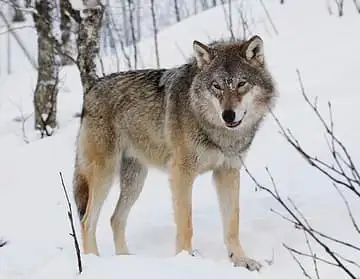
Gray wolves howl to keep in touch with their pack, and a howl can carry more than 10 km. A pack is usually a family of parents and their young, and its members cooperate to bring down large prey.
See it on the 3D globe →At a glance
- Class
- Mammals
- Lives in
- Boundary Waters, Minnesota, USA
- Diet
- Meat eater (carnivore)
- Weight
- about 40 kg
- Length
- about 1.7 m
- Top speed
- about 60 km/h
- Lifespan
- up to about 16 years
- Conservation status
- Least Concern (IUCN LC)
- Habitat
- forests, grasslands, mountains, polar regions
Quick answers
Where does the Gray wolf live?
It lives in forests, grasslands, mountains, polar regions. On the globe you can find it near Boundary Waters, Minnesota, USA.
How big is the Gray wolf?
It grows to about 1.7 m and 40 kg.
What does the Gray wolf eat?
Its diet: meat eater (carnivore).
How fast is the Gray wolf?
It can reach about 60 km/h.
How long does the Gray wolf live?
It can live up to about 16 years.
Is the Gray wolf endangered?
It is listed as Least Concern (IUCN LC).
The gray wolf, also called simply the wolf, is the largest wild member of the dog family. It lives in forests, mountains, tundra and grasslands across Eurasia and North America. Its fur is usually a mix of gray, brown, white and black, though wolves in the Arctic can be almost pure white.
Wolves are built for teamwork. They live in packs that are usually families: a mated pair and their young. Together they hunt large animals such as deer, and they keep in touch by howling. A howl can carry for many kilometres. The IUCN lists the gray wolf as Least Concern, and the world population is estimated at 200,000 to 250,000.
Life in the pack
A pack is a family. The parents lead, and the young may stay for a while before leaving to start packs of their own, usually when they are grown and food gets scarce at home.
Wolves are territorial, and fights with neighbouring packs over territory are one of the main ways wolves die. They talk with body language, growls and group howls.
Wolves, dogs and people
Wolves have a long and complicated history with humans. Farmers who keep livestock have often feared and hunted them, while some hunting and farming cultures respected them. Attacks on people are rare, and most recorded ones came from wolves with rabies.
Scientists count the domestic dog as a descendant of wolves, which is why the two animals can look and behave alike in some ways.
Fun facts
- Domestic dogs are descended from wolves that lived tens of thousands of years ago.
- The gray wolf is the biggest wild member of the dog family.
- Single wolves or pairs often hunt more successfully than large packs.
- Wolves can have fertile pups with coyotes and golden jackals, their smaller relatives.
On the globe
The globe places the gray wolf in the Boundary Waters of Minnesota. Look for the wolf standing in its forest home.
Quiz time
Which is heavier: Gray wolf or Striped skunk?
Show the answer
Gray wolf. (40 kg vs 3 kg) Striped skunk →
More like this


Sources
Updated: 2026-10-14