
North Atlantic right whale
북대서양긴수염고래
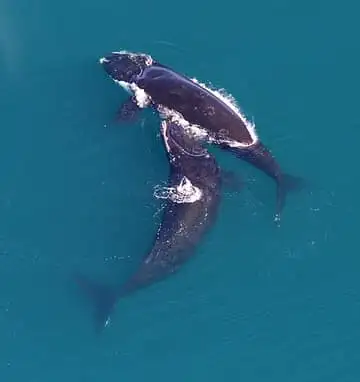
A huge whale some 15 m long and weighing tens of tonnes, marked by pale rough patches on its head that identify each animal. It swam slowly and was easy to hunt, and now fewer than 400 remain, making it one of the most endangered whales.
See it on the 3D globe →At a glance
- Class
- Mammals
- Diet
- Filter feeder
- Weight
- about 55,000 kg
- Length
- about 15 m
- Lifespan
- up to about 70 years
- Conservation status
- Critically Endangered (IUCN CR)
- Habitat
- coasts, open ocean
Quick answers
Where does the North Atlantic right whale live?
It lives in coasts, open ocean of the Atlantic Ocean.
How big is the North Atlantic right whale?
It grows to about 15 m and 55,000 kg.
What does the North Atlantic right whale eat?
Its diet: filter feeder.
How long does the North Atlantic right whale live?
It can live up to about 70 years.
Is the North Atlantic right whale endangered?
It is listed as Critically Endangered (IUCN CR).
The North Atlantic right whale is a huge baleen whale, one of the most endangered large whales in the world. It is dark grey to black and has no fin on its back. Its head makes up about a quarter of its length, and rough white patches of hardened skin called callosities cover its head. Each whale has its own pattern, so scientists can tell them apart.
An adult is usually 13 to 18 metres long and weighs about 40,000 to 90,000 kilograms. Today, an estimated 380 or so remain, including only about 70 breeding females. The IUCN lists the species as Critically Endangered. In winter, mothers give birth off Georgia and Florida, and in the warm months the whales feed to the north, in waters that reach as far as the Labrador Sea.
Why it is called the right whale
Whalers called it the right whale to hunt because it is slow, swims close to the coast, and floats after being killed. Its thick blubber also gave lots of whale oil, which made each animal very valuable. Hunting brought the species close to disappearing. It is now protected by laws in the United States and Canada, such as the US Endangered Species Act and Canada's Species at Risk Act, but it still faces serious threats.
Dangers today
The two greatest dangers are being hit by ships and getting tangled in fishing gear that stays in the water. Together they have caused nearly half of the deaths known since 1970. The whales migrate through busy shipping lanes along the east coast of North America. Callosities host colonies of small whale lice, and scientists use the lice near the blowhole as a sign of a whale's health.
Fun facts
- Whalers called it the "right" whale to hunt because it swims slowly near shore and floats after it dies.
- A right whale's blow is shaped like a heart, because of its V-shaped blowhole.
- Right whales have no fin on the back.
- Each whale's callosity pattern is unique, so scientists can recognise individuals.
On the globe
The globe shows the North Atlantic right whale in the Atlantic. Look for the huge dark body with no fin on its back.
Quiz time
Which is heavier: North Atlantic right whale or Eastern gray squirrel?
Show the answer
North Atlantic right whale. (55,000 kg vs 0.5 kg) Eastern gray squirrel →
More like this



.jpg)
Sources
Updated: 2026-10-14