
Humboldt squid
훔볼트오징어
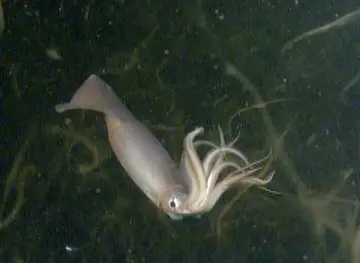
A red squid up to about 1.5 m long that hunts in shoals of hundreds. It flashes between red and white with skin pigment cells, apparently to signal to others in the dark.
See it on the 3D globe →At a glance
- Class
- Molluscs
- Lives in
- Humboldt Current, southeastern Pacific
- Diet
- Meat eater (carnivore)
- Lifespan
- up to about 2 years
- Conservation status
- Data Deficient (IUCN DD)
- Habitat
- open ocean, deep sea
Quick answers
Where does the Humboldt squid live?
It lives in open ocean, deep sea of the Pacific Ocean. On the globe you can find it near Humboldt Current, southeastern Pacific.
What does the Humboldt squid eat?
Its diet: meat eater (carnivore).
How long does the Humboldt squid live?
It can live up to about 2 years.
Is the Humboldt squid endangered?
It is listed as Data Deficient (IUCN DD).
The Humboldt squid, Dosidicus gigas, also called the jumbo squid or red devil, is a big predatory squid of the eastern Pacific Ocean. It usually reaches a mantle length of about 1.5 metres, and some grow to around 50 kg, which makes it the largest member of its family and one of the largest squids.
It is most often found at depths of 200 to 700 metres, from Tierra del Fuego to California, and in recent decades has been spreading north to Oregon, Washington, British Columbia and Alaska. It lives only about 1 to 2 years. It is the most important squid in world fisheries, with most of the catch landed in Chile, Peru and Mexico.
Flashing red and white
Special skin cells called chromatophores let the squid change colour at lightning speed. When other squid are near, the whole body flashes red and white two to four times a second, and what it is saying is still unknown. Another, slower mode sends waves of red and white rippling along the body, which may be camouflage that copies sunlight moving through water.
Fishermen in Baja California call it diablo rojo, red devil, because it flashes when caught.
Hunters in the dark
Humboldt squid move in shoals of up to about 1,200 and can swim at up to 24 km/h. They rise toward the surface from dusk to dawn and sink back in the day. They eat small fish, especially lanternfish, plus crustaceans, copepods and other cephalopods.
Two elastic tentacles shoot out to grab prey, holding it with suckers that each have a ring of teeth. The prey is then pulled toward a razor-sharp beak. They have a reputation for aggression toward people, though that may only happen at feeding time.
A changing range
The Humboldt squid was first reported to science in 1782 by the Chilean priest Juan Ignacio Molina, and the genus Dosidicus was created in 1857. It lives mainly off Chile and Peru.
Warm El Nino years seem to push it north. Squid first appeared in Monterey Bay after the 1997 to 1998 El Nino and have been seen there year-round since 2002. A fishery in the Gulf of California collapsed in 2015 as waters warmed and has not recovered.
Fun facts
- Nicknamed the 'red devil', it can flash red and white by changing the colour of its skin.
- It can flash its whole body between red and white two to four times a second.
- Between 1,000 and 1,500 squid washed up on a Washington beach in late 2004.
- Its two tentacles are covered in suckers with toothed rings.
- Chileans call it jibia and Peruvians call it pota.
On the globe
Look in the Humboldt Current off Peru and Chile; the card shows the red squid that flashes when hunting.
More like this

Sources
Updated: 2026-10-14