
Abalone
전복
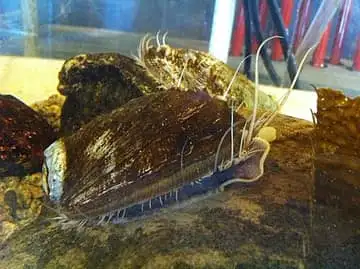
The abalone clings to rocks with a single ear-shaped shell lined with shimmering mother-of-pearl. It grazes slowly on seaweed, and breathing water leaves through a row of small holes along the shell's edge.
See it on the 3D globe →At a glance
- Class
- Molluscs
- Diet
- Plant eater (herbivore)
- Habitat
- coasts, coral reefs
Quick answers
Where does the Abalone live?
It lives in coasts, coral reefs of the Pacific, Atlantic and Indian oceans.
What does the Abalone eat?
Its diet: plant eater (herbivore).
Abalone are sea snails of the genus Haliotis. They cling to rocks with a single flat, ear-shaped shell that is lined inside with shimmering mother-of-pearl. About 70 species are known today, living in oceans around the world.
Most abalone are between 2 and 20 cm long. The biggest species, the red abalone, can reach about 30 cm. A row of small holes along the edge of the shell is used for breathing. The flesh is widely seen as a delicacy and is eaten raw or cooked in many cuisines. The pretty inside of the shell is also why people have valued it for ornaments, jewelry, buttons and inlay since prehistory.
Shell and body
The shell is low and convex, with a small flat spire. Its last whorl is shaped like an ear, which is why abalone are also called ear shells. Near the edge runs a row of holes, between 8 and 38 over a lifetime, but only four to ten are open at one time; older holes seal up as the shell grows. Water from the gills leaves through these holes, and so do eggs and sperm.
The inner layer of nacre can shine silvery white, pink, red, blue, green or purple. An abalone has an unusually big, muscular foot that holds it tight to the rock.
Life on the rocks
Abalone live along the coasts of every continent except a few, and most species prefer cold waters off New Zealand, South Africa, Australia, western North America and Japan. They cling to rock below the low-tide line and feed on large seaweeds, preferring red or brown kinds. A single female can lay from 10,000 up to 11 million eggs at a time. The oldest known fossil abalone come from the Late Cretaceous, in North America.
Names and a tough shell
Abalone have different names around the world: ear shells or sea ears, ormer in the United Kingdom, perlemoen in South Africa and pāua in New Zealand. The word abalone came into English via Spanish from a word in the Rumsen language.
The shell is extremely strong. It is made of tightly packed calcium carbonate layered with protein, so a hard blow tends to shed layers instead of shattering it. Scientists study it for ideas on stronger protective gear such as body armour.
Fun facts
- The shiny inside of its shell is mother-of-pearl, used in jewellery and inlay.
- There are about 70 abalone species.
- The largest species can grow to about 30 cm.
- The shiny shell lining is the same material people call mother-of-pearl.
- One abalone can lay from 10,000 to 11 million eggs at a time.
On the globe
The model shows an abalone with its ear-shaped shell clinging to a rock. Look for the row of small holes along the shell edge.
More like this

Sources
Updated: 2026-10-14