
Queen conch
퀸콘크
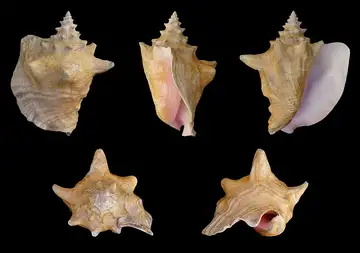
The queen conch is a large sea snail of Caribbean seagrass beds and sandy bottoms. Its heavy spiked shell has a broad flared lip glossy pink inside, and the animal has eyes on long stalks. The shell reaches about 30 cm, and the species is heavily fished.
See it on the 3D globe →At a glance
- Class
- Molluscs
- Lives in
- Seagrass beds and sandy flats of the Caribbean, here the Bahamas bank off Cuba
- Diet
- Plant eater (herbivore)
- Length
- about 0.25 m
- Habitat
- coasts, coral reefs
Quick answers
Where does the Queen conch live?
It lives in coasts, coral reefs of the Atlantic Ocean. On the globe you can find it near Seagrass beds and sandy flats of the Caribbean, here the Bahamas bank off Cuba.
How big is the Queen conch?
It grows to about 0.25 m.
What does the Queen conch eat?
Its diet: plant eater (herbivore).
The queen conch (Aliger gigas) is a large sea snail of the Caribbean and the tropical north-western Atlantic. It is one of the biggest molluscs of the region, and its shell can reach about 35 centimetres. The shell is heavy, with knob-like spines and a broad, flared lip that is glossy pink or orange inside.
It lives on seagrass beds and sandy flats, where it grazes on plants and algae. The animal has eyes on long stalks, a long snout and a strong foot. Queen conchs are heavily fished for meat and shells, so international trade is regulated under the CITES agreement.
Shell and body
Juvenile conchs have no flared lip. It develops when the snail reaches reproductive age, and the thicker the lip, the older the conch. The shell is sandy coloured on the outside, which helps it blend in with the sea floor. Many small animals use the conch as a home, including slipper snails, porcelain crabs and a fish called the conchfish.
People and conchs
Humans have caught queen conchs since prehistoric times, and the shells were used as tools by Native Americans and other Caribbean peoples. Today the shells are sold as souvenirs. The queen conch is also eaten by sea turtles, nurse sharks, octopus and other predators, so it is an important food for many reef animals. Shells and meat are both valued, which is why the species is heavily fished.
Fun facts
- Its big shell is blown like a horn, and it can produce rare pink pearls.
- The big shell can be blown like a horn.
- It can rarely make pink pearls.
- The thicker its flared lip, the older it is.
On the globe
The model shows a queen conch on the seagrass and sand of the Bahamas bank off Cuba. Look for the pink flared lip.
Quiz time
Which is longer: Queen conch or Common octopus?
Show the answer
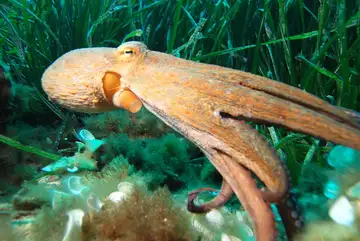
Common octopus. (0.25 m vs 1 m) Common octopus →
More like this

Sources
Updated: 2026-10-14