
Indian rhinoceros
인도코뿔소
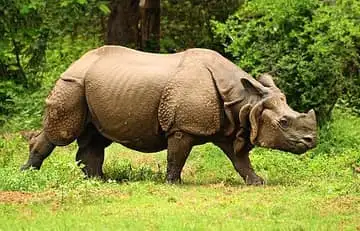
A one-horned rhino whose thick skin folds look like a suit of armour. It can weigh close to 2 tonnes yet swims well and grazes mostly on grass. Kaziranga National Park is home to most of the world's population.
See it on the 3D globe →At a glance
- Class
- Mammals
- Lives in
- Kaziranga National Park, Assam, India
- Diet
- Plant eater (herbivore)
- Weight
- about 1,900 kg
- Length
- about 3.5 m
- Top speed
- about 55 km/h
- Lifespan
- up to about 47 years
- Conservation status
- Vulnerable (IUCN VU)
- Habitat
- grasslands, wetlands, forests
Quick answers
Where does the Indian rhinoceros live?
It lives in grasslands, wetlands, forests. On the globe you can find it near Kaziranga National Park, Assam, India.
How big is the Indian rhinoceros?
It grows to about 3.5 m and 1,900 kg.
What does the Indian rhinoceros eat?
Its diet: plant eater (herbivore).
How fast is the Indian rhinoceros?
It can reach about 55 km/h.
How long does the Indian rhinoceros live?
It can live up to about 47 years.
Is the Indian rhinoceros endangered?
It is listed as Vulnerable (IUCN VU).
The Indian rhinoceros, also called the greater one-horned rhino, lives on the Indian subcontinent. It is the second largest rhino in the world and the largest in Asia. Adult males weigh around 2.1 to 2.2 tonnes, and females about 1.6 tonnes. Its grey-brown skin has pinkish folds, and its shoulders and upper legs are covered with wart-like bumps.
It has a single horn that can reach about 57 to 62 centimetres. The rhino lives in 12 protected areas in northern India and southern Nepal. It is listed as Vulnerable. In the early 1990s only about 1,870 to 1,895 were left, but conservation raised the count to roughly 4,075 by March 2025.
Grazer of the grasslands
Indian rhinos are mostly solitary and graze, eating grass but also leaves, twigs, fruit, flowers and water plants. They swim well, as the globe card says. A female has one calf after a pregnancy of about 15.7 months, and she waits three to four years before the next birth. In captivity they can live up to 47 years. Parasites like leeches and ticks, and diseases like anthrax, can make them ill.
Kaziranga and conservation
Kaziranga National Park in Assam holds about two thirds of all Indian rhinos. Hunting and farming once shrank their range greatly, and poaching for horns remains a constant danger. Linnaeus gave the species its scientific name in 1758, and the word rhinoceros comes from Greek words for nose and horn. Government protection has helped the population grow, but it is still confined to small areas.
Fun facts
- Kaziranga National Park in India is home to about two-thirds of all Indian rhinos.
- Kaziranga holds about two thirds of all Indian rhinos.
- Its population rose from under 1,900 in the early 1990s to about 4,075 in 2025.
- Rhinoceros means nose horn in Greek.
On the globe
Look in Kaziranga National Park, Assam; the card shows the single horn and armour-like skin folds.
Quiz time
Which is heavier: Indian rhinoceros or Red panda?
Show the answer
Indian rhinoceros. (1,900 kg vs 5 kg) Red panda →
More like this

Sources
Updated: 2026-10-14