
Bharal
바랄
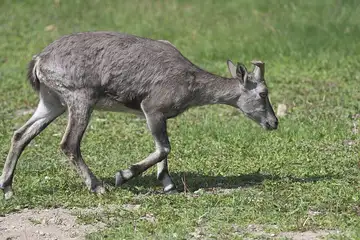
The bharal, or Himalayan blue sheep, is a blue-grey wild bovid of the Himalaya and Tibetan plateau, sharing traits of both sheep and goats. It is one of the main prey animals of the snow leopard.
See it on the 3D globe →At a glance
- Class
- Mammals
- Lives in
- Himalaya and the Tibetan plateau
- Diet
- Plant eater (herbivore)
- Weight
- about 50 kg
- Conservation status
- Least Concern (IUCN LC)
- Habitat
- mountains
Quick answers
Where does the Bharal live?
It lives in mountains. On the globe you can find it near Himalaya and the Tibetan plateau.
How big is the Bharal?
It grows to about 50 kg.
What does the Bharal eat?
Its diet: plant eater (herbivore).
Is the Bharal endangered?
It is listed as Least Concern (IUCN LC).
The bharal, also called the Himalayan blue sheep, is a wild mountain animal of the high Himalayas. It lives on alpine meadows and rocky slopes in Bhutan, China, India, Myanmar, Nepal and Pakistan, usually between 2,200 and 5,500 metres above sea level.
Its slate-grey coat has a bluish tint, which gives it the name blue sheep. Even though it is called a sheep, studies show it is genetically closer to goats. It is also one of the main prey animals of the snow leopard. The bharal is the only member of its genus, and scientists recognise two main subspecies, the Himalayan blue sheep and the Chinese blue sheep. Its home is among the rocky cliffs.
Life on the cliffs
The bharal is mostly a grazer that eats grasses, but it will browse shrubs when food is scarce. Its grey coat blends with rock, and it shelters under cliffs to avoid predators. It is a medium-sized animal, about 115 to 165 centimetres long and 35 to 75 kilograms. Its slate-grey fur blends with the rocky cliffs. It lives in alpine meadows and on rocky slopes, and it usually stays at high altitudes of 2,200 to 5,500 metres.
Horns and mating season
Both males and females carry horns, but the males' curved horns are larger and can reach about 80 centimetres. Mating, called the rut, runs from late November to mid-January, when males use various moves to win mates. The IUCN lists the bharal as Least Concern, although poaching and competition with livestock can cause problems. Males use various manoeuvres to win mates during the rut. In many mountain valleys the bharal is also the staple food of the snow leopard, which makes it important for the whole mountain ecosystem.
Fun facts
- It is the main prey of the snow leopard in the Himalayas.
- The bharal's name is the Hindi word for the animal; English speakers call it blue sheep for its bluish fur.
- Its genus name Pseudois means 'false sheep'.
- It lives as high as about 5,500 metres, where the air is thin.
On the globe
The model shows a blue-grey wild bovid with curved horns. Look for it in the high mountains of the Himalaya.
Quiz time
Which is heavier: Bharal or Nilgai?
Show the answer
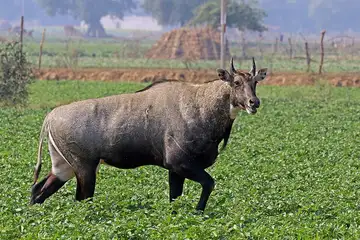
Nilgai. (50 kg vs 180 kg) Nilgai →
More like this


Sources
Updated: 2026-10-14