
Himalayan tahr
히말라야타르
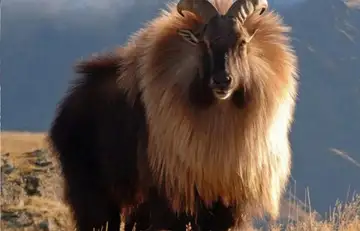
A stocky wild goat of the steep forests and cliffs of the Himalaya. Males have a long reddish mane and short, flat horns that curve back. It was also introduced to New Zealand, where it thrives.
See it on the 3D globe →At a glance
- Class
- Mammals
- Lives in
- Himalaya, Nepal and northern India
- Diet
- Plant eater (herbivore)
- Conservation status
- Near Threatened (IUCN NT)
- Habitat
- mountains
Quick answers
Where does the Himalayan tahr live?
It lives in mountains. On the globe you can find it near Himalaya, Nepal and northern India.
What does the Himalayan tahr eat?
Its diet: plant eater (herbivore).
Is the Himalayan tahr endangered?
It is listed as Near Threatened (IUCN NT).
The Himalayan tahr is a stocky wild goat that lives on the steep forested slopes and cliffs of the Himalayas, in southern Tibet, northern India, western Bhutan and Nepal. Males grow a thick reddish coat, and both sexes have short horns that curve backwards.
It is listed as Near Threatened because hunting and habitat loss are shrinking the wild population in its homeland. People have also carried tahr to other countries, including New Zealand, Argentina, South Africa and the United States, where some herds now live far from the Himalayas.
What does a tahr look like?
Himalayan tahr have small heads, pointed ears and large eyes. Their horns can reach about 46 centimetres, and the backward curve helps prevent injuries when males butt heads in the mating season. Males are bigger than females, averaging roughly 73 kilograms against about 36 kilograms. Thick reddish wool and a heavy undercoat keep them warm in the cold mountains, and the coat grows thinner and lighter in colour as winter ends. Like all hoofed animals of its group, it has an even number of toes and can grip both smooth and rough rock.
Where did tahr come from, and where do they live now?
Scientists place tahr in the goat and sheep subfamily, and a recent study suggests the Himalayan tahr is actually a wild goat. The English word tahr was first written down in 1835 and comes from a local name in the western Himalayas. Tahr were later introduced to New Zealand, where the herd now roams the Southern Alps after arriving in 1904. In their native range they are declining, so protecting mountain habitat matters for their future.
Fun facts
- The genus name Hemitragus comes from Greek words meaning half goat.
- A tahr's backward-curving horns help keep males safe when they headbutt each other.
- Tahr brought to New Zealand in 1904 now live in the Southern Alps, on the other side of the world from the Himalayas.
On the globe
Look for the model on steep mountain ground in the Himalaya, where this goat lives; the card shows the long reddish mane and short backward horns.
More like this

Sources
Updated: 2026-10-14