
Javan rhinoceros
자바코뿔소
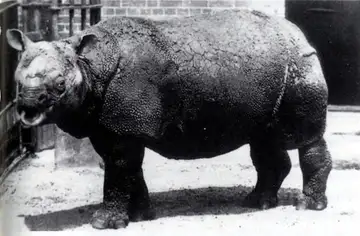
A one-horned rhino whose skin folds look like plates of armour. Today it survives only in Ujung Kulon National Park at the western tip of Java, with fewer than about 80 animals. It is critically endangered.
See it on the 3D globe →At a glance
- Class
- Mammals
- Lives in
- Ujung Kulon National Park, Java, Indonesia
- Diet
- Plant eater (herbivore)
- Weight
- about 1,600 kg
- Length
- about 3.1 m
- Conservation status
- Critically Endangered (IUCN CR)
- Habitat
- rainforests
Quick answers
Where does the Javan rhinoceros live?
It lives in rainforests. On the globe you can find it near Ujung Kulon National Park, Java, Indonesia.
How big is the Javan rhinoceros?
It grows to about 3.1 m and 1,600 kg.
What does the Javan rhinoceros eat?
Its diet: plant eater (herbivore).
Is the Javan rhinoceros endangered?
It is listed as Critically Endangered (IUCN CR).
The Javan rhinoceros is a critically endangered rhino with a single small horn and plate-like skin folds. Its body is 3.1 to 3.2 metres long, and the heaviest animals weigh about 2,300 kilograms. It is one of the smallest rhino species and one of the rarest large mammals on Earth.
Long ago it ranged across Java, Sumatra, mainland Southeast Asia, northeast India, Bhutan and southern China. Today the only known wild population, about 74 animals, lives in Ujung Kulon National Park at the western tip of Java, Indonesia. No Javan rhino is kept successfully in captivity.
Why so few are left
Poaching of males for their horns, which are highly valued in traditional Chinese medicine, caused the main decline. Trophy hunting during the colonial era, loss of habitat and rapid human population growth made things worse. Ujung Kulon is a protected area and a UNESCO World Heritage Site, but the park boundaries are hard to guard everywhere, so poachers, disease and low genetic variety remain risks.
Life in the forest
The rhino once lived in lowland rainforest, wet grassland and floodplains at forest edges. It is mostly solitary and may live around 30 to 45 years in the wild. Its horn is usually shorter than 25 centimetres. Because all the animals live in one place, a single disaster such as a disease or a tsunami could be dangerous, which is why scientists want to give them a second safe home.
Fun facts
- One of the rarest large mammals, fewer than 100 survive, all in Ujung Kulon National Park on Java.
- Fewer than about 80 Javan rhinos survive, all in one park.
- Their horns are usually shorter than 25 centimetres.
- None are kept successfully in captivity.
On the globe
Look in Ujung Kulon National Park, Java; the card shows the armour-like folds of its skin.
Quiz time
Which is heavier: Javan rhinoceros or Bornean orangutan?
Show the answer
Javan rhinoceros. (1,600 kg vs 57 kg) Bornean orangutan →
More like this


Sources
Updated: 2026-10-14