
Dugong
듀공
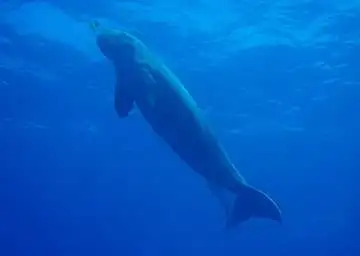
A 'sea cow' that grazes only on seagrass and is said to have inspired mermaid legends. Its closest living land relatives are elephants, and a dugong can live for nearly 70 years.
See it on the 3D globe →At a glance
- Class
- Mammals
- Lives in
- Off the Pilbara coast, Western Australia
- Diet
- Plant eater (herbivore)
- Weight
- about 320 kg
- Length
- about 2.7 m
- Top speed
- about 20 km/h
- Lifespan
- up to about 70 years
- Conservation status
- Vulnerable (IUCN VU)
- Habitat
- coasts
Quick answers
Where does the Dugong live?
It lives in coasts of the Indian and Pacific oceans. On the globe you can find it near Off the Pilbara coast, Western Australia.
How big is the Dugong?
It grows to about 2.7 m and 320 kg.
What does the Dugong eat?
Its diet: plant eater (herbivore).
How fast is the Dugong?
It can reach about 20 km/h.
How long does the Dugong live?
It can live up to about 70 years.
Is the Dugong endangered?
It is listed as Vulnerable (IUCN VU).
The dugong is a gentle marine mammal of warm coastal waters of the Indian and western Pacific oceans. It is one of four living members of the order Sirenia, the 'sea cows', which also includes three manatees. It is the only living member of its family. Its closest modern relative, Steller's sea cow, was hunted to extinction in the 18th century.
Dugongs eat seagrass, so they live only where seagrass meadows grow, in wide, shallow, sheltered places such as bays and mangrove channels. Their range covers the waters of about 40 countries and territories, and northern Australia, between Shark Bay and Moreton Bay, is believed to be a stronghold. An adult is rarely longer than 3 metres. The IUCN lists the dugong as vulnerable to extinction, and the main causes are fishing deaths, loss of habitat and hunting.
Not a manatee, not a mermaid
A dugong can be told from a manatee by its tail, which has two flukes like a dolphin's, and by its sharply downturned snout, which is made for feeding on the seabed. The big upper lip forms a mobile muzzle with bristles. The skin is pale cream at birth and darkens to brown or dark grey, sometimes coloured by algae. The word dugong comes from the Visayan language of the Philippines and does not mean 'lady of the sea', even though sailors may have mistaken sea cows for mermaids.
Elephants' cousins
Dugongs are not closely related to dolphins or seals. Their nearest relatives on land are elephants, together with hyraxes and the aardvark. Sirenians have a fossil record about 50 million years long and are the only plant-eating marine mammals. Males grow two tusks, which emerge at puberty. Females have tusks too, but theirs often stay hidden. Unlike manatees, dugongs do not replace their teeth throughout life.
A slow life
A dugong can live 70 years or more, but it reproduces slowly, so populations recover slowly from losses. Adults usually weigh between 250 and 900 kilograms. The largest on record was 4.06 metres long and weighed 1,016 kilograms, found off western India. For thousands of years people have hunted dugongs for meat and oil, and traditional hunting is still culturally important in northern Australia and the Pacific Islands.
Fun facts
- The dugong's closest living relatives on land are elephants.
- Its closest relatives on land are elephants.
- Unlike manatees, it has a dolphin-like tail with two flukes.
- Dugongs can live 70 years or more.
- Newborns are pale cream and darken as they grow.
On the globe
The model shows a plump sea cow with a downturned snout and a fluked tail, as in the card. Look at the snout and tail.
Quiz time
Which is heavier: Dugong or Greater bilby?
Show the answer
Dugong. (320 kg vs 1.4 kg) Greater bilby →
More like this

Sources
Updated: 2026-10-14