
Bluespotted ribbontail ray
청점줄가오리
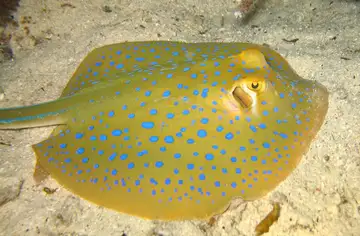
A small stingray of Indo-Pacific reef flats, olive-tan with bright blue spots and blue stripes on its tail. It has a venomous tail spine and glides into shallows at high tide to hunt.
See it on the 3D globe →At a glance
- Class
- Fish
- Lives in
- Reef sand flats of the southern Red Sea off Yemen
- Diet
- Meat eater (carnivore)
- Habitat
- coral reefs
Quick answers
Where does the Bluespotted ribbontail ray live?
It lives in coral reefs of the Indian and Pacific oceans. On the globe you can find it near Reef sand flats of the southern Red Sea off Yemen.
What does the Bluespotted ribbontail ray eat?
Its diet: meat eater (carnivore).
The bluespotted ribbontail ray is a small stingray with a colourful pattern: bright electric-blue spots on a yellowish background, and a pair of blue stripes along its tail. It is oval and smooth, with big eyes that stick out, and it is no wider than about 35 centimetres.
It lives in shallow, warm water near the coast, in coral reef areas of the tropical Indian Ocean and the western Pacific, from the shoreline down to about 30 metres. The globe places it on the reef sand flats of the southern Red Sea, off Yemen. At night, small groups follow the rising tide onto sandy flats to dig for small animals living in the sand. When the tide goes out, the rays split up and hide in the reef.
Blue means careful
The ray's tail carries venomous spines. The spines can injure a person, but the ray usually prefers to swim away if it is threatened. The bright blue spots are thought to be a warning sign. Bluespotted ribbontail rays eat small animals that live in the sand, and small bony fish. They are popular aquarium animals, but they do not cope well in captivity.
Name and family
The species was first described in 1775 by the Swedish naturalist Peter Forsskål. It has many other names, including bluespotted fantail ray and lagoon ray. Females give birth to live young, in litters of up to seven. The ray lives in a very wide area, from South Africa and the Arabian Peninsula to the Philippines and northern Australia, and around many islands such as Madagascar, the Maldives and Sri Lanka.
Fun facts
- Its bright blue spots warn that its tail carries venomous spines.
- Its tail has venomous spines, but it prefers to flee rather than sting.
- At high tide the rays glide onto sand flats to feed, and they retreat to the reef when the tide goes out.
- It was named in 1775 by the Swedish naturalist Peter Forsskål.
On the globe
The globe places the ray on the reef sand flats of the southern Red Sea off Yemen. Look for the bright blue spots and blue tail stripes.
More like this

Sources
Updated: 2026-10-14