
Platypus
오리너구리
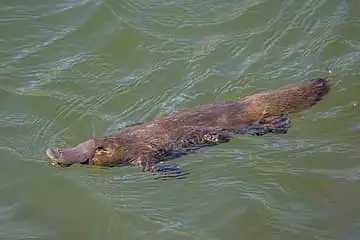
One of the few egg-laying mammals, with a duck-like bill and a beaver-like tail. Underwater it hunts with its eyes shut, sensing the faint electric signals of prey with its bill, and males carry a venomous spur on the hind leg.
See it on the 3D globe →At a glance
- Class
- Mammals
- Lives in
- Central Queensland, Australia
- Diet
- Meat eater (carnivore)
- Weight
- about 1.4 kg
- Length
- about 0.45 m
- Top speed
- about 3.6 km/h
- Lifespan
- up to about 21 years
- Conservation status
- Near Threatened (IUCN NT)
- Habitat
- rivers & lakes
Quick answers
Where does the Platypus live?
It lives in rivers & lakes. On the globe you can find it near Central Queensland, Australia.
How big is the Platypus?
It grows to about 0.45 m and 1.4 kg.
What does the Platypus eat?
Its diet: meat eater (carnivore).
How fast is the Platypus?
It can reach about 3.6 km/h.
How long does the Platypus live?
It can live up to about 21 years.
Is the Platypus endangered?
It is listed as Near Threatened (IUCN NT).
The platypus is a small furry animal that lives in rivers, creeks and ponds in eastern Australia, from the warm rainforests of northern Queensland down to the chilly mountains of Tasmania. It has a soft, flat bill like a duck, a broad flat tail like a beaver, webbed feet and thick brown waterproof fur. Most adults are 40 to 60 centimetres long, about the length of a house cat.
The platypus is a mammal, so it has fur and feeds its babies milk, but it also lays eggs. Only a handful of mammals do this: the platypus and the echidnas, which together are called monotremes. When the first platypus skin reached Britain in 1798, some scientists thought someone had sewn a duck's bill onto a furry animal as a trick. It was real, and it is still one of the most unusual animals on Earth.
Amazing body
When a platypus dives, it closes its eyes, ears and nostrils. So how does it find food? Its bill is covered with about 40,000 tiny sensors that pick up the weak electric signals given off by moving prey, as well as touch sensors that feel ripples in the water. This sense is called electroreception, and very few mammals have it. Adults have no teeth; they grind food with hard pads instead. Males have a sharp spur on each back ankle that can inject venom, which is painful for people, making the platypus one of the few venomous mammals.
What it eats
The platypus is a carnivore that hunts mostly at night and at dusk. It dives for 30 seconds to a little over two minutes at a time, poking its bill into the gravel and mud on the stream bottom. It eats insect larvae, worms, shrimp, freshwater crayfish, small mussels and tadpoles. Instead of eating each bite right away, it stuffs the food into pouches in its cheeks, then floats at the surface to chew. A platypus may spend 10 to 12 hours a day looking for food.
Family life
A mother platypus digs a long burrow in a river bank, which can be up to 30 metres long, and lines a nest with wet leaves and grass. She usually lays two small leathery eggs, each about 17 millimetres long, and curls around them to keep them warm. The babies hatch blind and hairless. The mother has no nipples, so milk oozes out through patches on her belly skin for the young to lap up. The young leave the burrow at about four months old. The platypus is listed as Near Threatened because it is harmed by pollution, getting caught in fishing gear and climate change.
Fun facts
- It is one of only a few mammals that lay eggs; the others are the echidnas.
- British scientists who saw the first platypus skin suspected it was a fake made by stitching parts of different animals together.
- A platypus hunts underwater with its eyes, ears and nose all shut, sensing prey with its bill.
- Adult platypuses have no teeth and chew with hard grinding pads instead.
- A platypus mother has no nipples; her babies drink milk that seeps out of her skin.
- When a mother returns to her burrow, squeezing past soil plugs she built squeezes water out of her fur.
On the globe
The model shows a platypus in central Queensland, Australia, with its duck-like bill and wide beaver-like tail. Look closely at its bill, the special sensor it uses to hunt with its eyes closed.
Quiz time
Which is heavier: Platypus or Dingo?
Show the answer
Dingo. (1.4 kg vs 15 kg) Dingo →
More like this

_Scottsdale.jpg)
Sources
Updated: 2026-10-13