
Red kangaroo
붉은캥거루
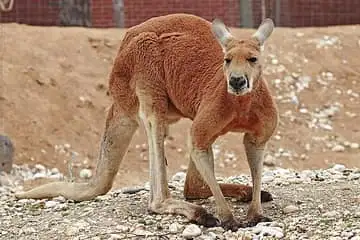
The red kangaroo is the largest marsupial, with big males about 1.5 m tall. It can bound nearly 8 m in a hop and reach about 60 km/h. A tiny newborn joey crawls into the pouch and grows there for months.
See it on the 3D globe →At a glance
- Class
- Mammals
- Lives in
- Outback, Australia
- Diet
- Plant eater (herbivore)
- Weight
- about 50 kg
- Length
- about 2.1 m
- Lifespan
- up to about 23 years
- Conservation status
- Least Concern (IUCN LC)
- Habitat
- grasslands, deserts, savannas
Quick answers
Where does the Red kangaroo live?
It lives in grasslands, deserts, savannas. On the globe you can find it near Outback, Australia.
How big is the Red kangaroo?
It grows to about 2.1 m and 50 kg.
What does the Red kangaroo eat?
Its diet: plant eater (herbivore).
How long does the Red kangaroo live?
It can live up to about 23 years.
Is the Red kangaroo endangered?
It is listed as Least Concern (IUCN LC).
The red kangaroo, Osphranter rufus, is the largest of all kangaroos, the largest land mammal native to Australia, and the largest living marsupial. It lives across mainland Australia, mostly in scrubland, grassland and desert, and avoids the more fertile areas such as the southwest, the eastern coasts and the northern rainforests. It likes open ground with some trees for shade.
Males have short red-brown fur, while females are smaller and often blue-grey. A male's head and body are 1.3 to 1.6 metres long, with a tail that adds about 1.2 metres, and weighs 55 to 90 kg. Females weigh 18 to 40 kg. Australians call big males Big Reds. The strong tail props the animal up like a tripod when it stands. The species was first described in 1822 and is common.
How it hops
The legs work like a rubber band: the Achilles tendon stretches as the kangaroo lands, then springs back to push it up and forward. Red kangaroos can reach about 60 km/h. Males can cover 8 to 9 metres in one leap and reach heights of 1.8 to 3 metres, though average jumps are shorter.
Their eyes sit on the sides of the head, giving about 300 degrees of vision. If chased into water, a kangaroo can swim, and it may even use its forepaws to hold an attacker under the water.
Surviving the heat and the dry
Red kangaroos keep their body at about 36 degrees Celsius with a thick coat, resting in shade, panting, sweating and licking their forearms. They can eat plants that are very salty, and their kidneys save water, so they can go a long time without drinking.
They mostly graze at dusk and at night and rest in the shade by day. They eat green plants, mainly grasses, and one study found green grass was 75 to 95 percent of their diet. In droughts they travel 25 to 30 km to find fresh food. Groups are small, but where food is plentiful as many as 1,500 can gather.
Joeys
A red kangaroo can breed all year. The newborn emerges after only 33 days. It is blind, hairless and a few centimetres long, and it crawls through its mother's fur into the pouch in about three to five minutes. It then clamps onto a teat and grows quickly.
After about 190 days the joey first sticks out, and around 235 days it leaves the pouch for good, though it keeps suckling until about 12 months. A mother can pause the growth of the next embryo until the pouch is free. Fights among males are often boxing matches that decide who mates.
Fun facts
- The kangaroo appears on Australia's coat of arms alongside the emu.
- A newborn joey is only a few centimetres long and climbs into the pouch by itself.
- The largest confirmed red kangaroo stood about 2.1 metres tall.
- A mother can pause a new pregnancy until her previous joey leaves the pouch.
- Males box each other standing up on their tails.
On the globe
Look in the Australian outback; the card highlights its strong hind legs for hopping.
Quiz time
Which is heavier: Red kangaroo or Greater bilby?
Show the answer
Red kangaroo. (50 kg vs 1.4 kg) Greater bilby →
More like this

Sources
Updated: 2026-10-14