
Raggiana bird-of-paradise
라지아나극락조
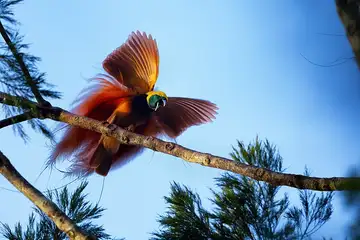
The male has a yellow head, emerald throat, flowing orange-red flank plumes and two wire-like tail streamers. Males gather in trees for courtship displays. It is the national bird of Papua New Guinea.
See it on the 3D globe →At a glance
- Class
- Birds
- Lives in
- Southern Papua New Guinea forests
- Diet
- Eats both plants and meat (omnivore)
- Length
- about 0.34 m
- Conservation status
- Least Concern (IUCN LC)
- Habitat
- rainforests
Quick answers
Where does the Raggiana bird-of-paradise live?
It lives in rainforests. On the globe you can find it near Southern Papua New Guinea forests.
How big is the Raggiana bird-of-paradise?
It grows to about 0.34 m.
What does the Raggiana bird-of-paradise eat?
Its diet: eats both plants and meat (omnivore).
Is the Raggiana bird-of-paradise endangered?
It is listed as Least Concern (IUCN LC).
The Raggiana bird-of-paradise is a large, spectacular bird from New Guinea. The male has a yellow crown, a dark emerald-green throat, long orange-red plumes on his sides and two thin black tail wires. It is the national bird of Papua New Guinea, where it is called kumul, and it appears on the national flag.
The bird is about 34 centimetres long and lives in the tropical forests of southern and north-eastern New Guinea. It eats mainly fruit and small arthropods such as insects, and in this way it helps spread the seeds of forest trees, including some mahogany and nutmeg trees. The IUCN rates it Least Concern, because it is common across eastern New Guinea.
Dancing in the treetops
Males gather in groups at display areas called leks, which can be 30 to 100 metres wide. Each male defends a perch in the tall, slender trees and performs for visiting females by clapping his wings and shaking his head while showing off his plumes. The female picks a mate and then does everything else alone. She builds a bowl-shaped nest from leaves, stems and fibres, 2 to 11 metres above the ground, and lays one or two pinkish eggs.
Colour and a famous name
The ornamental flank plumes vary from red to orange, depending on the subspecies. The one called Empress of Germany's bird-of-paradise, from the north-east, has apricot-orange plumes. The female is a much plainer maroon-brown, without the yellow crown, green throat or long plumes of the male. The species was named after Marquis Francesco Raggi of Genoa. It is also covered by international trade rules, being listed in Appendix II of CITES.
Fun facts
- It is the national bird of Papua New Guinea and appears on the national flag.
- The Papua New Guinea national rugby league team is nicknamed the Kumuls, after this bird.
- Only the male has the two long, wire-like tail feathers; the female does not.
- It is one of the main fruit-eaters that spreads the seeds of some wild nutmeg and mahogany trees.
On the globe
The globe shows the bird in the forests of southern Papua New Guinea. Look for the orange-red plumes of the male.
Quiz time
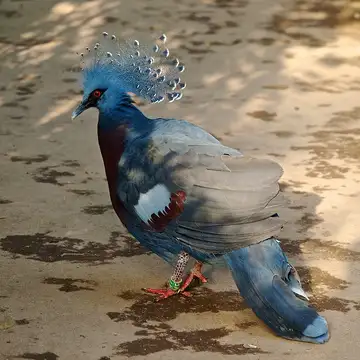
Which is longer: Raggiana bird-of-paradise or Victoria crowned pigeon?
Show the answer
Victoria crowned pigeon. (0.34 m vs 0.74 m) Victoria crowned pigeon →
More like this

Sources
Updated: 2026-10-14