
Rainbow lorikeet
무지개잉꼬
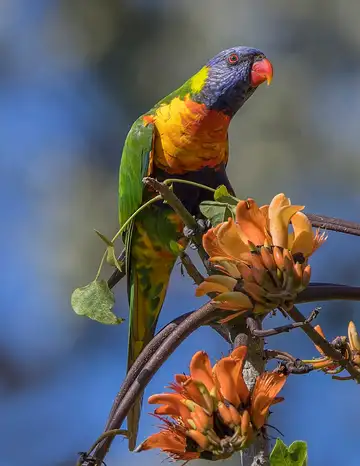
A colourful parrot with a blue head, green back and orange-red breast. Its tongue tip is brush-like for licking nectar and pollen. Noisy flocks live in Sydney and other city parks.
See it on the 3D globe →At a glance
- Class
- Birds
- Lives in
- Eastern Australia (Sydney)
- Diet
- Plant eater (herbivore)
- Weight
- about 0.12 kg
- Length
- about 0.28 m
- Conservation status
- Least Concern (IUCN LC)
- Habitat
- forests, towns & cities
Quick answers
Where does the Rainbow lorikeet live?
It lives in forests, towns & cities. On the globe you can find it near Eastern Australia (Sydney).
How big is the Rainbow lorikeet?
It grows to about 0.28 m and 0.12 kg.
What does the Rainbow lorikeet eat?
Its diet: plant eater (herbivore).
Is the Rainbow lorikeet endangered?
It is listed as Least Concern (IUCN LC).
The rainbow lorikeet, Trichoglossus moluccanus, is a bright parrot of Australia with a deep-blue head, a greenish-yellow collar, green wings and back, and an orange-yellow chest. It is 25 to 30 centimetres long including the tail and weighs 75 to 157 grams. It is common along the east coast, from northern Queensland south to South Australia, in rainforest, coastal bush and woodland.
It has also been brought to Perth in Western Australia, Tasmania, Auckland in New Zealand and Hong Kong. Males and females look the same, so a vet's test or a DNA test of a feather is needed to tell them apart. Its tongue ends in a brush-like tip that gathers pollen and nectar from flowers. According to the annual BirdLife Australia census it is the most commonly observed bird in Australia, and it is Least Concern.
Nectar, pollen and fruit
Rainbow lorikeets eat mainly fruit, pollen and nectar. Eucalyptus nectar is very important in Australia, and they also use grevillea, African tulip-tree and sago palm flowers. In Melanesia they pollinate coconuts. They eat figs, papayas and mangoes already opened by fruit bats, and they raid orchards, maize and sorghum.
Many wild lorikeets are used to people and can be hand-fed. At Currumbin Wildlife Sanctuary in Queensland, thousands of them gather in a noisy flock at about 8 am and 4 pm each day to eat nectar made for them.
Breeding
In southern Australia, breeding usually happens from late winter to early summer, August to January. Elsewhere it has been recorded in every month except March, depending on food and climate. Pairs nest in hollows of tall trees such as eucalypts, in palm trunks or under overhanging rock, and one island population in the Admiralty Islands nests in holes in the ground.
A clutch has one to three eggs, which the female alone incubates for around 25 days. Pairs are mostly monogamous and stay together for a long time, perhaps for life.
A name mix-up and a pest problem
In 1788 Johann Friedrich Gmelin named the species moluccanus because he believed the first specimens came from the Moluccas. The type locality was corrected to Botany Bay, Australia, in 1916. In 2019 the lorikeet in Australia was split into three: rainbow, coconut and red-collared lorikeets.
Orchard owners often see them as pests because flocks strip fruit trees, and city flocks are noisy and leave droppings. A group accidentally released in southwest Western Australia in the 1960s is now classed as a pest, because it competes with local birds such as Carnaby's black cockatoo for food and nest hollows.
Fun facts
- Its brush-tipped tongue is made for lapping up nectar and pollen.
- It is the most commonly observed bird in Australia in the annual BirdLife census.
- Its tongue has a brush-like tip for gathering pollen and nectar.
- Thousands gather to feed at Currumbin Wildlife Sanctuary twice a day.
- The first scientists mistakenly thought the bird came from the Moluccas.
On the globe
The model shows a rainbow lorikeet with a blue head and orange-red chest in eastern Australia.
Quiz time
Which is heavier: Rainbow lorikeet or Laughing kookaburra?
Show the answer
Laughing kookaburra. (0.12 kg vs 0.33 kg) Laughing kookaburra →
More like this
_Sydney.jpg)
Sources
Updated: 2026-10-14