
Red-crowned crane
두루미
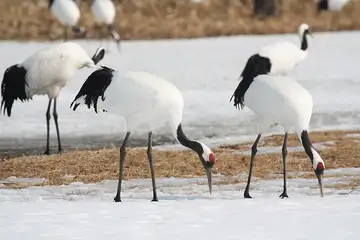
A tall white crane with a black neck and secondaries and a bare red crown. It lives in wetlands and pairs dance together in courtship. Some stay all winter on the Kushiro marshes of Hokkaido.
See it on the 3D globe →At a glance
- Class
- Birds
- Lives in
- Kushiro marshes, Hokkaido
- Diet
- Eats both plants and meat (omnivore)
- Weight
- about 8.5 kg
- Length
- about 1.4 m
- Conservation status
- Vulnerable (IUCN VU)
- Habitat
- wetlands
Quick answers
Where does the Red-crowned crane live?
It lives in wetlands. On the globe you can find it near Kushiro marshes, Hokkaido.
How big is the Red-crowned crane?
It grows to about 1.4 m and 8.5 kg.
What does the Red-crowned crane eat?
Its diet: eats both plants and meat (omnivore).
Is the Red-crowned crane endangered?
It is listed as Vulnerable (IUCN VU).
The red-crowned crane is a tall, snow-white crane of north-eastern Asia and one of the rarest cranes in the world. It is named for a patch of bare red skin on top of its head, which gets brighter in the mating season. Its neck and the back edge of its wings are black, and in much of East Asia it is a symbol of luck, long life and loyalty.
An adult stands about 150 centimetres tall, spans 2.2 to 2.5 metres with its wings open, and weighs on average about 8 to 9 kilograms, making it the heaviest crane on average. It lives in wetlands, eats fish, frogs, snails and plants, and some birds spend the whole winter on the Kushiro marshes of Hokkaido, Japan. The IUCN lists it as Vulnerable.
A dancing couple
Red-crowned cranes are famous for their courtship dances, in which a pair bows, leaps and calls together. Pairs stay together, and a family of parents and young stays as a group through the winter, which is unusual for migrating birds. Korean sources describe how older cranes can show the young a shorter way to their destination. In winter many gather in flocks of 100 or more where people put out food.
Looks that fool the eye
Many people think this crane has a black tail, but the real tail feathers are white. The black part is the wing's inner feathers, which cover the tail when the bird stands. Males have black cheeks, throat and neck, while females are pearly grey in those places. Young birds are a mix of white, cinnamon and grey-brown. The English name copies the Chinese and Japanese names meaning red-crowned crane.
Fun facts
- In East Asia it is a symbol of luck and long life; its red crown is a patch of bare skin.
- Its bare red crown is skin, not feathers.
- The crane's black rear is actually its folded wing feathers; the true tail is white.
- In some places the crane is a symbol of long life, and sources give lifespans from about 30 to 50 years or more.
On the globe
The globe places the crane on the Kushiro marshes of Hokkaido, Japan. Look for the white body, black neck and red crown.
Quiz time
Which is heavier: Red-crowned crane or Eurasian magpie?
Show the answer
Red-crowned crane. (8.5 kg vs 0.22 kg) Eurasian magpie →
More like this
.jpg)
Sources
Updated: 2026-10-14