
Eurasian magpie
까치
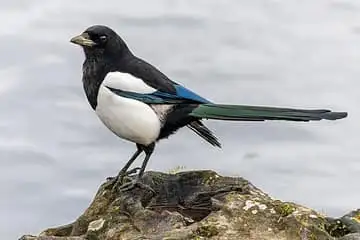
Regarded as a national bird of Korea and, since ancient times, a bearer of good news. It is very clever, one of the few animals known to recognise itself in a mirror, and builds a big domed nest of sticks.
See it on the 3D globe →At a glance
- Class
- Birds
- Lives in
- Throughout South Korea
- Diet
- Eats both plants and meat (omnivore)
- Weight
- about 0.22 kg
- Length
- about 0.45 m
- Lifespan
- up to about 21 years
- Conservation status
- Least Concern (IUCN LC)
- Habitat
- towns & cities, forests, grasslands
Quick answers
Where does the Eurasian magpie live?
It lives in towns & cities, forests, grasslands. On the globe you can find it near Throughout South Korea.
How big is the Eurasian magpie?
It grows to about 0.45 m and 0.22 kg.
What does the Eurasian magpie eat?
Its diet: eats both plants and meat (omnivore).
How long does the Eurasian magpie live?
It can live up to about 21 years.
Is the Eurasian magpie endangered?
It is listed as Least Concern (IUCN LC).
The Eurasian magpie (Pica pica) is a black-and-white bird of the crow family that lives across the northern part of Eurasia all year round. In Europe, when English speakers say magpie, they usually mean this species. In Korea it is regarded as a national bird and, since ancient times, a bearer of good news.
It is one of the most intelligent birds known. The expanded part of its brain, the nidopallium, is about as large for its body size as in chimpanzees, gorillas, orangutans and humans. It is one of the few animals known to pass the mirror test, which means it recognises itself in a mirror.
How we classify magpies
The magpie was first drawn by Swiss naturalist Conrad Gessner in 1555, and Linnaeus gave it a scientific name in 1758. The International Ornithological Congress recognises six subspecies.
It looks almost identical to the North American black-billed magpie, and the two were once treated as one species. They are not closely related to the Australian magpie, though they share the same colours and name.
A clever bird of towns and fields
Magpies live in forests, grasslands and cities, and they build big domed nests of sticks.
Because magpies are so clever and live near people, they are familiar neighbours in many places. A magpie can live around 21 years. In Korean tradition, seeing one is a sign that good news is on the way, which is why the bird has long been loved there.
Fun facts
- The magpie was one of the first non-mammals shown to recognise itself in a mirror.
- The Eurasian magpie passes the mirror test.
- Its brain region for thinking is as large, relative to its body, as in great apes and humans.
- It is not closely related to the Australian magpie.
- It builds a domed stick nest.
On the globe
The model shows a black-and-white magpie, a bird Koreans link with good news.
Quiz time
Which is heavier: Eurasian magpie or Red-crowned crane?
Show the answer
Red-crowned crane. (0.22 kg vs 8.5 kg) Red-crowned crane →
More like this


Sources
Updated: 2026-10-14