
Saker falcon
세이커매
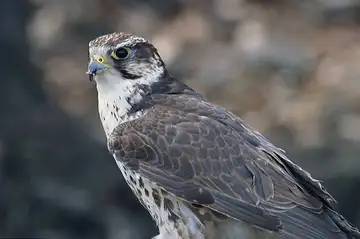
A large falcon of open steppe and semi-desert that hunts ground squirrels and other rodents. Its back is brown and its pale head is streaked. The wingspan can exceed about 1 metre.
See it on the 3D globe →At a glance
- Class
- Birds
- Lives in
- Central Asian steppe (Kazakhstan)
- Diet
- Meat eater (carnivore)
- Weight
- about 1 kg
- Length
- about 0.52 m
- Conservation status
- Endangered (IUCN EN)
- Habitat
- grasslands, deserts, mountains
Quick answers
Where does the Saker falcon live?
It lives in grasslands, deserts, mountains. On the globe you can find it near Central Asian steppe (Kazakhstan).
How big is the Saker falcon?
It grows to about 0.52 m and 1 kg.
What does the Saker falcon eat?
Its diet: meat eater (carnivore).
Is the Saker falcon endangered?
It is listed as Endangered (IUCN EN).
The saker falcon is a large falcon of open steppe and semi-desert. It breeds from central Europe across Asia to Manchuria. Its back is brown and its pale head is streaked. A saker is about 57 centimetres long and its wingspan is roughly 1 metre or more. It hunts ground squirrels and other rodents.
The saker is a partial migrant: some birds fly south, while others stay near home. Birds from Europe and western Asia winter in the Sahel region of Africa, and birds from the Altai Mountains winter on the Qinghai-Tibet Plateau. It is the national bird of Hungary, the United Arab Emirates and Mongolia. The IUCN lists the species as Endangered. The globe places it on the steppe of Kazakhstan.
A fast flyer
The saker is one of the fastest birds. In level flight it can reach about 150 kilometres per hour, and in a stooping dive, falling from above, speeds approach 300 kilometres per hour. Only the peregrine falcon and the golden eagle stoop faster. During migration, the birds cross the Middle East, the Arabian Peninsula and Pakistan, where they are exposed to illegal trapping.
Falconry and culture
Sakers have been used in falconry on the Arabian Peninsula since ancient times. Arabs call the bird Hur, which means free-bird, and it is a national emblem in many Arab countries. The saker belongs to a group of large falcons that interbreed easily, which makes them hard for scientists to sort out. Four subspecies are generally recognised, including one that lives on the high Tibetan plateau.
Fun facts
- It is the national bird of Hungary and Mongolia and has long been prized for falconry.
- Its name in Arabic, Hur, means free-bird.
- It is the national bird of Hungary, the United Arab Emirates and Mongolia.
- It can dive at nearly 300 kilometres per hour.
On the globe
The globe places the saker on the Central Asian steppe in Kazakhstan. Look for the brown back and pale streaked head.
Quiz time
Which is heavier: Saker falcon or Himalayan monal?
Show the answer
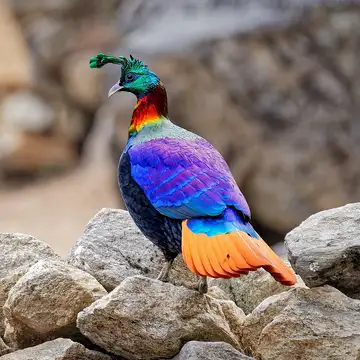
Himalayan monal. (1 kg vs 2.1 kg) Himalayan monal →
More like this
.jpg)
Sources
Updated: 2026-10-14