
Sarus crane
사루스두루미
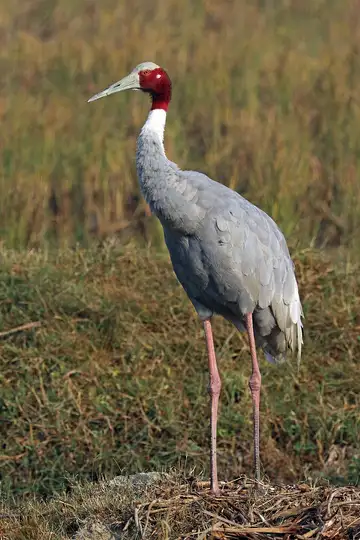
The tallest flying bird in the world, standing up to about 1.8 metres. It has a grey body, a bare red head and upper neck, and pink legs. Pairs mate for life and strengthen their bond with dancing and duet calls.
See it on the 3D globe →At a glance
- Class
- Birds
- Lives in
- Wetlands and paddy fields of the Gangetic plain in northern India and Nepal
- Diet
- Eats both plants and meat (omnivore)
- Weight
- about 7.3 kg
- Conservation status
- Vulnerable (IUCN VU)
- Habitat
- wetlands, grasslands
Quick answers
Where does the Sarus crane live?
It lives in wetlands, grasslands. On the globe you can find it near Wetlands and paddy fields of the Gangetic plain in northern India and Nepal.
How big is the Sarus crane?
It grows to about 7.3 kg.
What does the Sarus crane eat?
Its diet: eats both plants and meat (omnivore).
Is the Sarus crane endangered?
It is listed as Vulnerable (IUCN VU).
The sarus crane (Antigone antigone) is a large crane that does not migrate, and it is the tallest of the flying birds, standing up to 1.8 metres. It is found in parts of the Indian subcontinent, Southeast Asia and northern Australia, in open wetlands, seasonally flooded forests and eucalyptus woodlands. It is easy to tell from other cranes in the region because it is grey with a contrasting red head and upper neck.
India is its stronghold, and the largest known population lives in Uttar Pradesh, where small farms, friendly farmers, flooded paddy fields and a large network of canals help it. In many other places it has disappeared. The IUCN lists it as vulnerable. In India it is a symbol of marital fidelity, believed to pair for life and to pine when it loses its mate.
Nests that are islands
The main breeding season is in the wet season. The pair builds an enormous nest island, a round platform of reeds and grasses nearly two metres across and high enough to stay above the shallow water around it. Breeding pairs defend territories with a large repertoire of calls and displays.
Cranes search marshes and shallow wetlands for roots, tubers, insects, crustaceans and small vertebrates. Pairs perform loud trumpeting, leaps and dance-like movements as part of territorial and courtship displays.
Not all in one flock
Non-breeding birds gather in flocks of anywhere from one to 430 birds. The largest known flocks are in Keoladeo National Park, with as many as 430, and on community-owned wetlands in Etawah and Mainpuri in Uttar Pradesh. In India four patterns of behaviour have been noted, from cranes that stay in one place all year to ones that move to wetlands in the dry summer and back to territories in the rainy season.
Most of the sarus crane population in South Asia lives in farmland close to people, where it is traditionally revered.
A bird of legend
Legend says the poet Valmiki cursed a hunter for killing a sarus crane, and was then inspired to write the epic Ramayana. The crane almost became India's national bird, a close rival to the peafowl. Among the Gondi people, some tribes consider it sacred, and old Hindu scriptures treated its meat as taboo. In parts of Gujarat it is customary to take a newlywed couple to see a pair of sarus cranes.
The scientific name Antigone comes from Greek myth. Linnaeus chose it in 1758, probably confusing a story about a woman turned into a stork with one about a queen turned into a crane.
Fun facts
- Standing up to about 1.8 m tall, it is the tallest bird that can fly.
- It is the tallest bird that can fly.
- Its nest is an island of reeds almost two metres wide.
- In India it is seen as a symbol of marriage and faithfulness.
- The Mughal emperor Jahangir bred sarus cranes in captivity in the early 1600s.
On the globe
The toy model shows a sarus crane in the wetlands and paddy fields of northern India and Nepal.
Quiz time
Which is heavier: Sarus crane or Himalayan monal?
Show the answer
Sarus crane. (7.3 kg vs 2.1 kg) Himalayan monal →
More like this
.jpg)
Sources
Updated: 2026-10-14