
Western capercaillie
큰뇌조
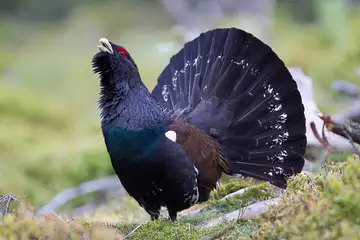
The largest grouse of northern European conifer forests; males can top 4 kg. In spring displays the cock fans his tail and gives a strange, clicking and popping song.
See it on the 3D globe →At a glance
- Class
- Birds
- Lives in
- Taiga forests of Finland
- Diet
- Plant eater (herbivore)
- Weight
- about 3.2 kg
- Length
- about 0.7 m
- Conservation status
- Least Concern (IUCN LC)
- Habitat
- forests
Quick answers
Where does the Western capercaillie live?
It lives in forests. On the globe you can find it near Taiga forests of Finland.
How big is the Western capercaillie?
It grows to about 0.7 m and 3.2 kg.
What does the Western capercaillie eat?
Its diet: plant eater (herbivore).
Is the Western capercaillie endangered?
It is listed as Least Concern (IUCN LC).
The western capercaillie is the largest grouse in the world. It is a heavy, mostly ground-living bird of old conifer forests across northern Europe and the wider Palearctic, from Scandinavia and Finland to Siberia. Males are nearly twice as big as females, and a big male can weigh more than 4 kilograms.
Spring is show time. The male fans his tail, puffs out his chest and sings a strange mix of clicks and pops to impress females. Overall the species is rated Least Concern by the IUCN, but in central Europe the populations are shrinking and split into pieces, and in some places they may already be gone.
Where does it live and what does it eat?
Capercaillies live in big, quiet forests, mostly pine and other conifers, and spend most of their time on the ground. The card for this animal on the globe places it in the taiga of Finland. In winter the bird survives almost entirely on pine needles, which are tough and poor food, so it must eat a lot of them to get through the cold months.
A name from Scotland and a very odd size gap
The name comes from the Scottish Gaelic words capall coille, meaning "horse of the woodland", and was settled in its modern spelling in 1843. The species was formally described by Carl Linnaeus in 1758. The two sexes differ greatly: males are nearly double the weight of females. The closest relative is the black-billed capercaillie, which lives in the larch forests of eastern Russia.
Fun facts
- In winter it survives almost entirely on pine needles.
- Its name means "horse of the woodland" in Scottish Gaelic.
- Males can weigh more than 4 kilograms, nearly twice as much as females.
- In winter it lives almost entirely on pine needles.
- The biggest known specimen was reported to reach 7.2 kilograms.
On the globe
The model stands in the taiga forests of Finland. Look for a big dark bird with a fanned tail, like a male in his spring display.
Quiz time
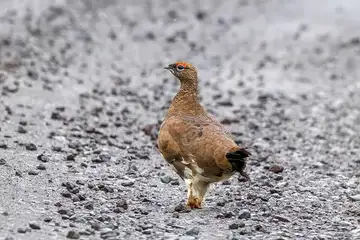
Which is heavier: Western capercaillie or Rock ptarmigan?
Show the answer
Western capercaillie. (3.2 kg vs 0.5 kg) Rock ptarmigan →
More like this

Sources
Updated: 2026-10-14