
Slow loris
늘보로리스
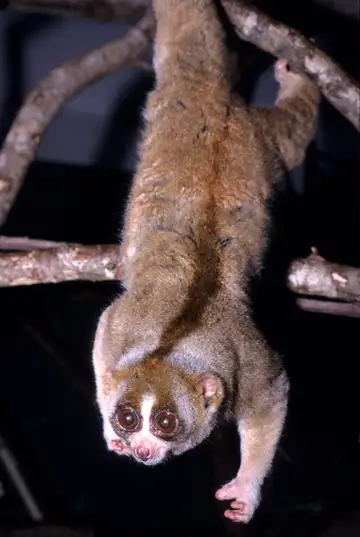
The slow loris is a small nocturnal primate with huge round eyes and dark eye rings. It climbs through trees very slowly, eating fruit and insects. It is one of the few venomous mammals, producing toxin from a gland on its arm.
See it on the 3D globe →At a glance
- Class
- Mammals
- Lives in
- Tropical forests of Southeast Asia (e.g. Cambodia)
- Diet
- Eats both plants and meat (omnivore)
- Habitat
- rainforests
Quick answers
Where does the Slow loris live?
It lives in rainforests. On the globe you can find it near Tropical forests of Southeast Asia (e.g. Cambodia).
What does the Slow loris eat?
Its diet: eats both plants and meat (omnivore).
The Sunda slow loris (Nycticebus coucang), also called the greater slow loris, is a small, night-active primate native to Indonesia, West Malaysia, southern Thailand and Singapore. It measures 27 to 38 centimetres from head to tail and weighs between about 600 and 685 grams. Like other slow lorises it has a wet nose, a round head, small ears hidden in thick fur, a flat face, huge eyes and a tiny stump of a tail.
It lives in evergreen forests, preferring rainforest with a continuous dense canopy, and it has a very low metabolic rate for its size. The IUCN lists it as endangered. It is threatened mostly because of demand for exotic pets, and it has become one of the most common primates for sale at Indonesian pet markets. Forest loss is also severe in its range.
Slow but never clumsy
The fur is soft, thick and woolly, light to deep reddish brown, with dark rings around the eyes that meet a dark stripe down the back. Its movement is described as unique: it climbs on all four limbs, usually with three holding the support at any time, and changes direction or moves between branches with little noise and no change of speed.
Its hands have a strong grip and a shortened second finger. It can hang beneath a branch by one or both feet for long periods. It has a toothcomb of six forward-facing teeth on the lower jaw, which it uses to scrape gum off trees. Glands under its arms release a strong-smelling liquid used to communicate.
Night life
By day it sleeps rolled up in a ball in hidden parts of trees above the ground. At night it eats sap, flower nectar, fruit and insects, and it licks gum and sap from wounds in tree bark. It is mostly solitary: one study found only about 8 percent of its active time was spent near other lorises.
It is monogamous, and the young live with their parents. A mother gives birth to a single baby after about 192 days, and the young leave between 16 and 27 months of age, usually when mature.
Names and the pet trade
Its species name coucang comes from kukang, its Indonesian name. It is also called malu-malu, meaning shy, and in Thailand ling lom, the wind monkey. In Malaysia it is sometimes known as kongkang or kera duku. Some local people call it kuskus because they do not tell it apart from the cuscus, an Australasian possum.
Slow lorises are the most commonly traded protected primates in Southeast Asia. Sellers often pull out their teeth, which can cause infections with a death rate up to 90 percent, and an animal without teeth can never return to the wild. In 2007 the species was moved to CITES Appendix I, which bans international trade.
Fun facts
- Slow lorises are the only venomous primates; they lick a toxin from glands on their elbows.
- Its Thai name means wind monkey.
- It is a toothcomb user: six lower teeth work like a comb for scraping gum.
- Mothers usually give birth to one baby after about 192 days.
- In pet markets, lorises often have their teeth removed.
On the globe
The toy model shows a slow loris in the tropical forests of Southeast Asia, such as Cambodia.
More like this

Sources
Updated: 2026-10-14