
Lar gibbon
흰손긴팔원숭이
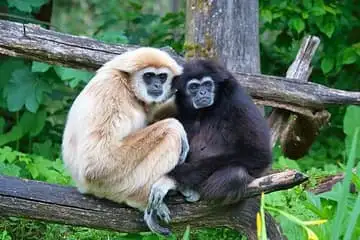
With its white hands and feet, the lar gibbon swings arm over arm through the canopy so fast it almost seems to fly. It is a tailless ape, and pairs sing loud duets together in the morning.
See it on the 3D globe →At a glance
- Class
- Mammals
- Lives in
- Tenasserim Hills, Thailand–Myanmar
- Diet
- Plant eater (herbivore)
- Weight
- about 6 kg
- Conservation status
- Endangered (IUCN EN)
- Habitat
- rainforests, forests
Quick answers
Where does the Lar gibbon live?
It lives in rainforests, forests. On the globe you can find it near Tenasserim Hills, Thailand–Myanmar.
How big is the Lar gibbon?
It grows to about 6 kg.
What does the Lar gibbon eat?
Its diet: plant eater (herbivore).
Is the Lar gibbon endangered?
It is listed as Endangered (IUCN EN).
The lar gibbon (Hylobates lar), also called the white-handed gibbon, is a small ape of the rainforests of Southeast Asia. It lives in Indonesia, Laos, Malaysia, Myanmar and Thailand, and it is easy to spot by its white hands and feet and the ring of pale hair around its dark face.
Gibbons are apes, not monkeys, and like all apes the lar gibbon has no tail. It is listed as endangered, mainly because its forest home has been shrinking and breaking into pieces. It is one of the better-known gibbons and is often kept in zoos. Its forest home is mostly lowland and hill rainforest.
Swinging through the trees
Lar gibbons are true brachiators, which means they travel by swinging from branch to branch with their arms. Their arms are extremely long, their fingers are curved like hooks and their legs are fairly short, a body plan that suits life in the treetops.
Gibbons also have tough pads of skin on their bottoms, called sitting pads, so they can rest comfortably on branches. Their fur can be black, brown or sandy, and males and females look much alike.
Where it lives and why it is endangered
Lar gibbons have the biggest north-south range of any gibbon species. They live in lowland and hill forests, usually not higher than about 1,200 metres above sea level.
In recent decades their range has been reduced and cut into patches, and they are probably extinct in China. The IUCN lists the species as endangered, so protecting forests matters for its future.
Fun facts
- Gibbons are apes, not monkeys, and have no tail.
- Lar gibbons have white hands and feet, which gives them the name white-handed gibbon.
- Apes such as gibbons have lost their tails, and the lar gibbon has no functional tail at all.
- Lar gibbons have the widest north-south range of all the gibbons.
- Gibbons have tough sitting pads on their bottoms for resting in trees.
On the globe
The model shows a lar gibbon with pale hands and feet, swinging through the Southeast Asian forest canopy.
Quiz time
Which is heavier: Lar gibbon or Malayan tapir?
Show the answer
Malayan tapir. (6 kg vs 290 kg) Malayan tapir →
More like this

Sources
Updated: 2026-10-14