
Asian elephant
아시아코끼리
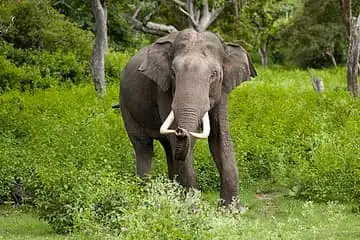
Smaller-eared than its African cousin, with a twin-domed forehead, it can weigh up to about 5 tonnes and eats over 100 kg of plants a day. It has worked alongside people for thousands of years.
See it on the 3D globe →At a glance
- Class
- Mammals
- Lives in
- Chiang Mai, Thailand
- Diet
- Plant eater (herbivore)
- Weight
- about 3,400 kg
- Length
- about 6 m
- Top speed
- about 40 km/h
- Lifespan
- up to about 75 years
- Conservation status
- Endangered (IUCN EN)
- Habitat
- forests, grasslands, rainforests
Quick answers
Where does the Asian elephant live?
It lives in forests, grasslands, rainforests. On the globe you can find it near Chiang Mai, Thailand.
How big is the Asian elephant?
It grows to about 6 m and 3,400 kg.
What does the Asian elephant eat?
Its diet: plant eater (herbivore).
How fast is the Asian elephant?
It can reach about 40 km/h.
How long does the Asian elephant live?
It can live up to about 75 years.
Is the Asian elephant endangered?
It is listed as Endangered (IUCN EN).
The Asian elephant is the largest land animal in Asia. It lives in forests and grasslands from India and Sri Lanka to Southeast Asia, including Thailand, Myanmar and the islands of Sumatra and Borneo. A grown male weighs about 4 tonnes on average and stands about 2.75 metres tall at the shoulder, while females are a little smaller.
Compared with African elephants, Asian elephants have smaller, rounder ears, a back that is level or rounded, and the highest point of the body on the head, which often has two bumps on top. People and Asian elephants have shared a long history: carvings more than 4,000 years old already show tamed elephants, and the animals have been honoured in Hindu and Buddhist traditions. Today, though, the species is endangered.
What it eats
Asian elephants are herbivores, which means they eat only plants. They munch on grasses, leaves, roots, bark and fruit, and scientists have recorded them feeding on more than 100 kinds of plants. An adult can eat up to about 150 kilograms of food a day and spends most of its waking hours eating. Elephants always stay near fresh water, because they need to drink a lot. They are most active at dawn and dusk. Sometimes they wander into farms to eat bananas, rice or sugarcane, which can cause trouble with farmers.
Family life
Mothers, their sisters and their calves travel together in small family groups. Young males leave the family when they are teenagers and then live alone or in loose groups of other males. Unlike African elephants, Asian elephant groups are fairly relaxed: they split up and join together again over time. A mother is pregnant for 18 to 22 months, the longest of any land animal, and usually has one calf. The baby weighs about 100 kilograms at birth and may drink its mother's milk for up to three years. In the wild they can live to about 60.
Is it endangered?
Yes. The Asian elephant has been listed as Endangered by the IUCN, the world's main group that tracks wildlife at risk, since 1986. About 50,000 are thought to live in the wild, and roughly three-quarters of them are in India. Elephants now live in only a small part of the land they once roamed. Forests are being cut down for farms, roads and towns, which breaks their homes into small pieces and leads to conflict with people. Poaching for ivory and the capture of young elephants are threats too.
Fun facts
- Usually only male Asian elephants grow tusks, and some males have none at all.
- Usually only male Asian elephants grow tusks, and some males never grow them at all.
- The tip of an Asian elephant's trunk has one finger-like point for picking up small things; African elephants have two.
- Elephants touch trunks to calm each other, a little like giving a hug.
- A baby elephant can spend almost two years growing inside its mother before it is born.
- Asian elephants are more closely related to the extinct woolly mammoths than to African elephants.
On the globe
The model shows an Asian elephant near Chiang Mai in northern Thailand. Look for its smaller ears and the twin bumps on its forehead that set it apart from its African cousin.
Quiz time
Which is heavier: Asian elephant or Saola?
Show the answer
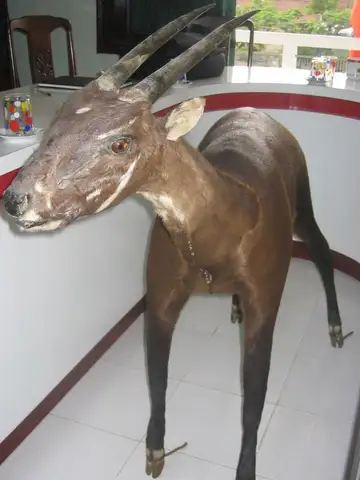
Asian elephant. (3,400 kg vs 90 kg) Saola →
More like this
.jpg)
Sources
Updated: 2026-10-13