
Vaquita
바키타
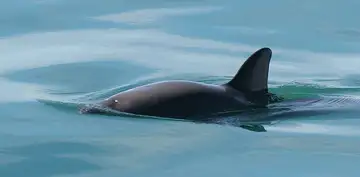
The vaquita is the world's smallest and rarest porpoise, living only in the far northern Gulf of California. It has a rounded head with dark rings round the eyes and dark lips, and is about 1.4 m long. Accidental netting has cut its numbers to very few.
See it on the 3D globe →At a glance
- Class
- Mammals
- Lives in
- Upper Gulf of California, Mexico only
- Diet
- Fish eater
- Weight
- about 45 kg
- Length
- about 1.4 m
- Conservation status
- Critically Endangered (IUCN CR)
- Habitat
- coasts
Quick answers
Where does the Vaquita live?
It lives in coasts of the Pacific Ocean. On the globe you can find it near Upper Gulf of California, Mexico only.
How big is the Vaquita?
It grows to about 1.4 m and 45 kg.
What does the Vaquita eat?
Its diet: fish eater.
Is the Vaquita endangered?
It is listed as Critically Endangered (IUCN CR).
The vaquita is the smallest living whale, dolphin or porpoise, and it lives nowhere else on Earth except the northern tip of the Gulf of California in Mexico. Its name is Spanish for 'little cow'. Adults are about 1.4 to 1.5 metres long, with a rounded head, no beak, a tall triangular fin, and dark rings around the eyes and lips.
It is also the most endangered marine mammal in the world, listed as Critically Endangered. Scientists only described it in 1958, and since then its numbers have fallen from about 567 in 1997 to roughly ten animals today. Its tall fin and dark eye patches make it look a little like a panda of the sea, which is why many people find it so appealing.
What threatens the vaquita?
The main danger is bycatch. Vaquitas get tangled and drown in gillnets, which are set to catch a large fish called the totoaba, whose illegal trade is the cause of the decline. Because the vaquita is so shy and rare, people rarely see it.
The site where it lives is a UNESCO World Heritage Site that was put on the 'in danger' list in 2019. The species was defined from skulls found on a beach, and fresh specimens were only studied in 1985.
Is there hope?
Monitoring in 2025 found 7 to 10 different animals, including new calves, so the species is still reproducing. Scientists also found that the vaquita's genes show it survived a big drop in numbers long ago, which may be why the few left are still healthy.
Protecting it depends on keeping illegal nets out of its small home range. Even so, it may be able to recover if the nets are kept out, because this small group is still healthy.
Fun facts
- With only about ten left, it is the world's rarest marine mammal; most were caught by accident in fishing nets.
- Its name is Spanish for 'little cow'.
- It was only described by scientists in 1958.
- Monitoring in 2025 saw 7 to 10 vaquitas, including new calves.
On the globe
The model shows the small, round-headed vaquita with dark rings around its eyes and lips.
Quiz time
Which is heavier: Vaquita or Gray whale?
Show the answer
Gray whale. (45 kg vs 27,000 kg) Gray whale →
More like this

Sources
Updated: 2026-10-14