
Pronghorn
가지뿔영양
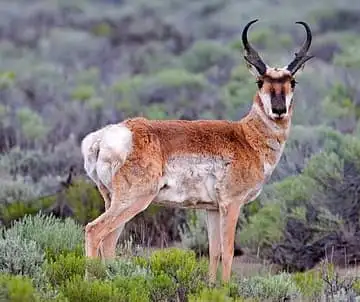
The pronghorn can sprint at about 90 km/h, making it the fastest land animal in the Americas. It also has great stamina and can keep up a fast pace for long distances. Despite the name it is not a true antelope.
See it on the 3D globe →At a glance
- Class
- Mammals
- Lives in
- Red Desert, Wyoming, USA
- Diet
- Plant eater (herbivore)
- Weight
- about 47 kg
- Top speed
- about 88 km/h
- Conservation status
- Least Concern (IUCN LC)
- Habitat
- grasslands, deserts
Quick answers
Where does the Pronghorn live?
It lives in grasslands, deserts. On the globe you can find it near Red Desert, Wyoming, USA.
How big is the Pronghorn?
It grows to about 47 kg.
What does the Pronghorn eat?
Its diet: plant eater (herbivore).
How fast is the Pronghorn?
It can reach about 88 km/h.
Is the Pronghorn endangered?
It is listed as Least Concern (IUCN LC).
The pronghorn (Antilocapra americana) is a hoofed animal of the open plains of interior western and central North America. It looks like an antelope, and people sometimes call it the American antelope, but it is not one. It is the only surviving member of its own family, Antilocapridae, and its closest living relatives are the giraffe and the okapi.
It is the fastest land mammal in the Americas, with running speeds up to 88.5 kilometres per hour. It has distinct white fur on its rump, sides, belly, breast and throat. Adult males stand 82 to 104 centimetres at the shoulder and weigh 40 to 65 kilograms, while females are the same height but lighter at 34 to 48 kilograms. Its feet have two hooves and no dewclaws.
Built for speed
A pronghorn can run 56 km/h for about 6.5 kilometres, 68 km/h for 1.5 kilometres, and 88.5 km/h for 800 metres. Its eyes are very large, with a field of vision of 320 degrees, so it can watch for danger across open ground.
Pronghorns prefer open land at heights of about 910 to 1,800 metres, and the healthiest herds stay within about 5 to 6.5 kilometres of water. They chew cud and eat many plants, including some that are unpalatable or poisonous to livestock.
Horns that fork
Both sexes have horns, though a female's are small, 1 to 6 centimetres, and rarely pronged. A horn has a bony core covered by a sheath of keratin, and the sheath is shed and regrown every year, unlike the horns of cattle or antelope. A male's sheath is about 12 to 43 centimetres long and has a forward-pointing prong, which gave the animal its name.
Spanish explorers saw pronghorns in the 16th century. Lewis and Clark described one near the mouth of the Niobrara River, in present-day Nebraska, in 1804. George Ord formally named it in 1815.
Herds and an ancient family
In winter pronghorns form mixed herds. In early spring the herds break up: young males form bachelor groups, females gather in harems, and adult males live alone. Where rainfall is high, adult males hold territories and mark them by scent. They try to scare rivals first, then lock horns if that fails.
About 11 other relatives lived in North America during the Pleistocene, many with long or spectacularly twisted horns, but only the pronghorn survives. Before Europeans arrived, the prairie was so full of bison, elk and pronghorn that it has been called the American Serengeti.
Fun facts
- It is the fastest land animal in the Americas and can keep up high speeds far longer than a cheetah.
- It is not a true antelope.
- Its closest living relatives are the giraffe and the okapi.
- It can run about 88 km/h, faster than any other land animal in the Americas.
- It is the symbol of the American Society of Mammalogists.
On the globe
The model shows a pronghorn in the Red Desert of Wyoming. Look for the forked horns and white rump.
Quiz time
Which is heavier: Pronghorn or Black-tailed prairie dog?
Show the answer
Pronghorn. (47 kg vs 1 kg) Black-tailed prairie dog →
More like this

Sources
Updated: 2026-10-14