
Angola: landmarks, animals & facts for kids
1 landmark
Angola on My Earth Toy, the free 3D toy globe for kids: 1 landmark. Here you can see its flag, capital and size, then fly to every place on the globe.
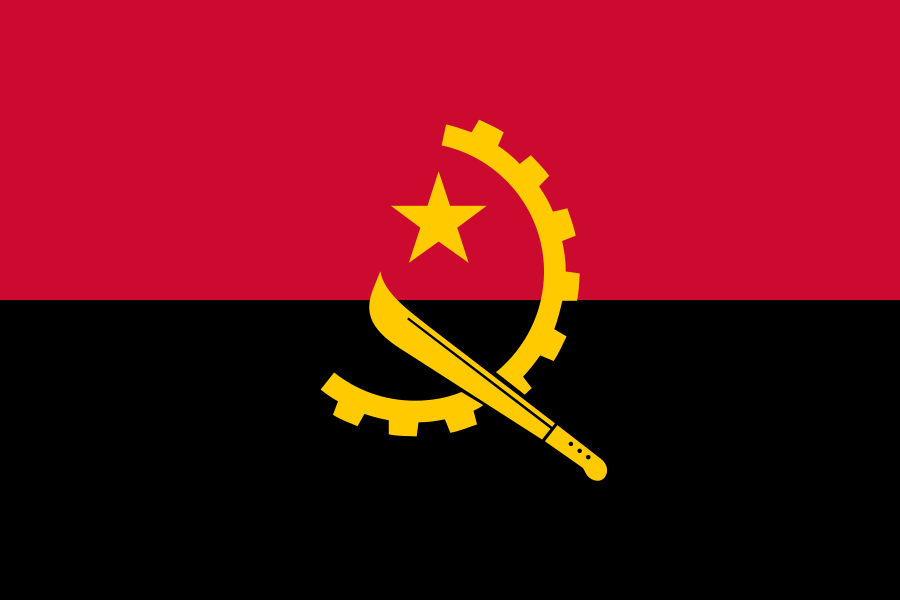
The flag of Angola is split into a red top half and a black bottom half, with a yellow emblem in the centre: half a cogwheel, a machete and a star.
Read about this flag →Angola at a glance
- Capital
- Luanda
- Continent
- Africa
- Area
- 1,246,700 km²
- Population
- 37.9 million
Angola is a large country on the Atlantic coast of southwestern Africa. Its capital is Luanda, a busy port city, and about 38 million people live in the country. Angola is known for its oil and diamonds, its long sandy coastline, the mighty Kalandula Falls and the rare giant sable antelope, a national symbol.
On My Earth Toy you can see the Mausoleum of Agostinho Neto in Luanda. It is the resting place of Angola's first president, a tall grey concrete tower about 120 metres high, shaped a bit like a rocket, that can be seen from all over the city.
Geography and nature
Angola has a narrow coastal plain that rises to a high central plateau. The north is warm and wet, with rainforest in the small exclave of Cabinda, which is separated from the rest of the country by a strip of land belonging to the Democratic Republic of the Congo. The far south is part of the Namib Desert, home to the strange welwitschia plant. Kalandula Falls on the Lucala River is one of Africa's largest waterfalls by volume.
People, languages and culture
Portuguese is Angola's official language, and many people also speak African languages such as Umbundu, Kimbundu and Kikongo. Most Angolans are Christian. Music and dance are a big part of life: semba is a traditional style, and kizomba, a smooth partner dance, became popular around the world. A common dish is funge, a thick porridge made from cassava or maize flour, served with fish or meat stews.
History in a nutshell
Long ago, the Kingdom of Kongo and other kingdoms ruled parts of the region. Portuguese sailors arrived in the late 1400s, and Luanda was founded in 1576. For centuries the area was a Portuguese colony and a centre of the Atlantic slave trade. Angola became independent on 11 November 1975. A long civil war followed and ended in 2002. Since then the country has rebuilt roads, cities and railways.
Fun facts
- Cabinda, part of Angola, does not touch the rest of the country.
- The giant sable antelope has curved horns that can be longer than 1.5 metres, and it lives only in Angola.
- The welwitschia plant of the Namib Desert grows just two long leaves for its whole life, which can last many centuries.
- Kizomba, a dance from Angola, is now taught in dance schools in many countries.
Famous landmarks in Angola
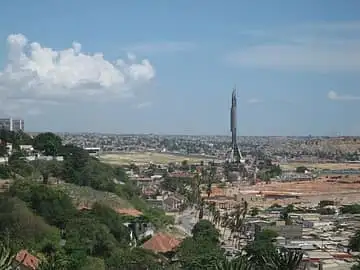
Mausoleum of Agostinho Neto
Angola · Africa
The resting place of Angola's first president, Agostinho Neto: a 120-metre grey concrete tower shaped like a rocket that can be seen from all over Luanda.
Questions
What is the capital of Angola?
The capital of Angola is Luanda.
Which continent is Angola in?
Angola is in Africa.
How big is Angola?
Angola covers about 1,246,700 km².
How many people live in Angola?
About 37.9 million people live in Angola.
What are the most famous landmarks in Angola?
On My Earth Toy's free 3D globe, the landmark from Angola is Mausoleum of Agostinho Neto, with a photo and quick facts.
Sources
Updated: 2026-10-30