
Belarus: landmarks, animals & facts for kids
1 landmark · 2 animals
Belarus on My Earth Toy, the free 3D toy globe for kids: 1 landmark, 2 animals. Here you can see its flag, capital and size, then fly to every place on the globe.
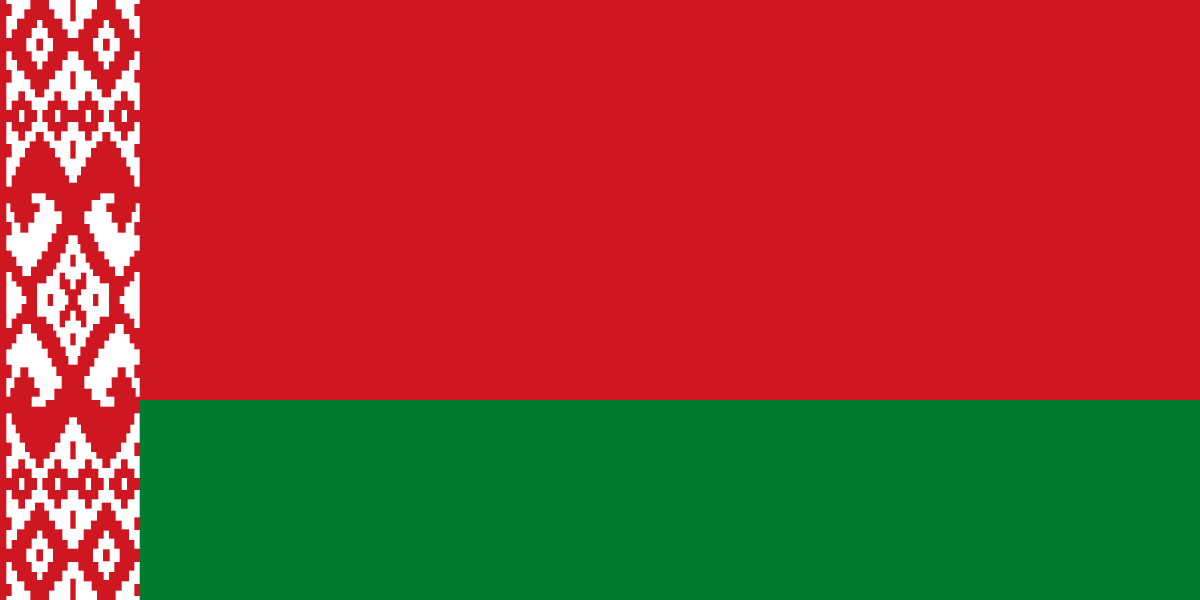
The flag of Belarus has a wide red stripe above a narrower green one, with a red-on-white folk pattern running down the side nearest the pole.
Read about this flag →Belarus at a glance
- Capital
- Minsk
- Continent
- Europe
- Area
- 207,600 km²
- Population
- 9.1 million
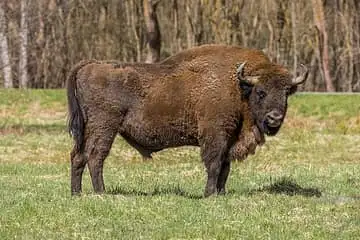
Belarus is a landlocked country in Eastern Europe, bordered by Russia, Ukraine, Poland, Lithuania and Latvia. Its capital is Minsk, and about 9 million people live there. Belarus is a land of flat plains, deep forests, rivers and thousands of lakes, and it is home to one of the last ancient lowland forests in Europe, where wild European bison roam.
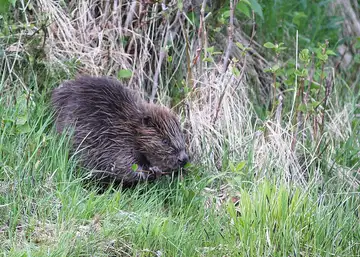
On My Earth Toy you can see the National Library of Belarus in Minsk, a glass building shaped like a giant cut gemstone that lights up in colours at night. Look out for two forest animals as well: the Eurasian beaver and the European bison.
Geography and nature
Belarus is mostly low and flat, with gentle hills and no mountains. Forests cover around 40 percent of the land, and the north has so many lakes that it is sometimes called the land of blue lakes. In the south lie the Polesie marshes, one of Europe's largest wetlands. Białowieża Forest, shared with Poland, is a UNESCO World Heritage Site and a refuge for European bison, wolves, lynx and many birds.
People, languages and culture
Belarusian and Russian are both official languages, and Russian is used most in daily life. Most believers are Eastern Orthodox Christians, with a Catholic minority. Potatoes are so central to cooking that many dishes are made from them, especially draniki, crispy potato pancakes served with sour cream. Folk traditions include embroidered linen with red patterns and the Kupalle summer festival, when people jump over bonfires and float wreaths on rivers.
History in a nutshell
In the Middle Ages the lands of Belarus were part of the Grand Duchy of Lithuania, and later the Polish-Lithuanian Commonwealth. In the late 1700s the area became part of the Russian Empire. After 1919 it was a republic within the Soviet Union. Belarus suffered enormous losses in World War II, and in 1986 it was badly affected by radiation from the Chernobyl disaster just across the border. Belarus became independent in 1991.
Fun facts
- The European bison is Europe's heaviest land animal, and Białowieża Forest helped save it from extinction.
- Beavers build dams on Belarusian rivers that can change whole streams into ponds.
- The National Library of Belarus has the shape of a rhombicuboctahedron, a solid with 26 faces.
- Belarus has around 10,000 lakes.
Famous landmarks in Belarus
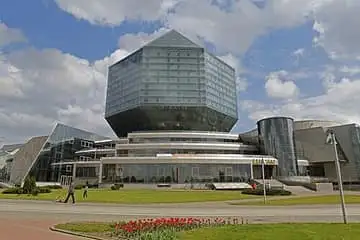
National Library of Belarus
Belarus · Europe
The national library of Belarus in Minsk, opened in 2006: a 23-storey, 73.6 m glass building shaped as a rhombicuboctahedron, a 26-faced solid.
Animals in Belarus
Questions
What is the capital of Belarus?
The capital of Belarus is Minsk.
Which continent is Belarus in?
Belarus is in Europe.
How big is Belarus?
Belarus covers about 207,600 km².
How many people live in Belarus?
About 9.1 million people live in Belarus.
What are the most famous landmarks in Belarus?
On My Earth Toy's free 3D globe, the landmark from Belarus is National Library of Belarus, with a photo and quick facts.
Which animals can you find in Belarus on My Earth Toy?
On the globe you can find Eurasian beaver and European bison in Belarus.
Sources
Updated: 2026-10-30