
European bison
유럽들소
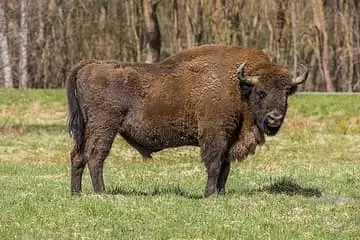
Europe's heaviest land animal, with big males approaching 900 kg. It vanished from the wild in the 1920s, then was bred back from zoo animals and returned to forests such as Białowieża.
See it on the 3D globe →At a glance
- Class
- Mammals
- Lives in
- Białowieża Forest, Poland
- Diet
- Plant eater (herbivore)
- Conservation status
- Near Threatened (IUCN NT)
- Habitat
- forests
Quick answers
Where does the European bison live?
It lives in forests. On the globe you can find it near Białowieża Forest, Poland.
What does the European bison eat?
Its diet: plant eater (herbivore).
Is the European bison endangered?
It is listed as Near Threatened (IUCN NT).
The European bison, also called the wisent or zubr, is the heaviest wild land animal in Europe. Males are 2.8 to 3.3 metres long, 1.8 to 2.1 metres tall at the shoulder and weigh 615 to 920 kg; females are smaller, at 424 to 633 kg. Compared with its American cousin, it has shorter hair on its head, neck and front, but a longer tail and horns. It is one of the national animals of Poland and Belarus.
By the Middle Ages bison were gone from most of Europe and Asia. In the early 20th century the remaining wild ones were hunted out: the last lowland animals were shot in the Białowieża Forest in 1921, and the last Caucasian wisent in 1927. The species survived in captivity, and breeding programmes have returned it to the wild in several countries. By the late 2010s there were several thousand, and the IUCN has changed its status from endangered to vulnerable and later near threatened.
Herds led by cows
Bison live in herds averaging 8 to 13 animals, made up of cows, calves and young animals, and in smaller male-only groups. Herds are not families; they meet, mix and quickly split. Specialists describe the society as a matriarchy because the cows lead the herd and decide where to graze. The biggest bulls often stay at the edge of the herd and become more active when danger appears or in the mating season, from August to October.
Food and calves
European bison eat grasses, sedges and herbs, and also browse shoots, twigs, bark and leaves. In summer an adult male can eat 32 kg of food a day. They must drink every day, and in winter they can be seen breaking ice with their heavy hooves. A cow usually has one calf after 264 days of pregnancy. A newborn weighs about 25 to 28 kg. In captivity they have lived as long as 30 years.
Back from the brink
The Białowieża Forest on the border of Poland and Belarus had the last lowland herds, and it is today the place with the world's largest population of European bison, including the wild ones. Hay has been fed to the bison there in winter for centuries. The animals are not tame like American bison, and they use their forward-pointing horns more for locking in fights than for charging. They can also make a growl-like sound, called chruczenie in Polish.
Fun facts
- It is the heaviest wild land animal in Europe.
- The last wild bison in the Białowieża Forest were shot in 1921, yet captive herds saved the species.
- The cows, not the bulls, lead the herd.
- In winter they break ice with their hooves to drink.
On the globe
The model shows a shaggy, humped bison with curved horns, as in the card. Look at the hump and horns.
More like this
_male_Bia%C5%82owieza.jpg)
Sources
Updated: 2026-10-14