
Eurasian beaver
유라시아비버
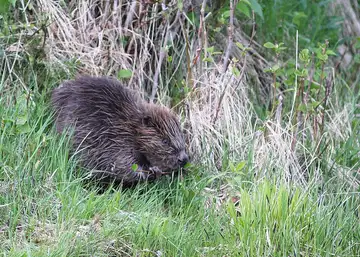
The Eurasian beaver is a large rodent of European and Asian rivers and lakes, the second biggest after the capybara. It swims with a flat tail and webbed hind feet and fells trees to build dams. Nearly extinct by the early 1900s, it has recovered thanks to protection.
See it on the 3D globe →At a glance
- Class
- Mammals
- Lives in
- Rivers and lakes of Europe and northern Asia (e.g. Belarus)
- Diet
- Plant eater (herbivore)
- Weight
- about 18 kg
- Length
- about 1.2 m
- Top speed
- about 8 km/h
- Lifespan
- up to about 25 years
- Conservation status
- Least Concern (IUCN LC)
- Habitat
- rivers & lakes, wetlands, forests
Quick answers
Where does the Eurasian beaver live?
It lives in rivers & lakes, wetlands, forests. On the globe you can find it near Rivers and lakes of Europe and northern Asia (e.g. Belarus).
How big is the Eurasian beaver?
It grows to about 1.2 m and 18 kg.
What does the Eurasian beaver eat?
Its diet: plant eater (herbivore).
How fast is the Eurasian beaver?
It can reach about 8 km/h.
How long does the Eurasian beaver live?
It can live up to about 25 years.
Is the Eurasian beaver endangered?
It is listed as Least Concern (IUCN LC).
The Eurasian beaver is one of the largest living rodents, and the largest rodent native to Eurasia. It is about 80 to 100 cm long with a 25 to 50 cm tail, and it weighs around 11 to 30 kg. By average weight it appears to be the world's second-heaviest rodent after the capybara. It lives in rivers, lakes and wetlands, and builds dams.
Around 1900 only about 1,200 were left in eight separate groups, after being hunted for fur and for castoreum, a scent-gland secretion thought to have medicinal value. Protection and reintroduction programmes then brought the numbers back to at least 1.5 million by 2020. It now lives in Western, Southern, Central and Eastern Europe, Scandinavia, Russia and on into China and Mongolia, with about half the population in Russia. It is listed as least concern on the IUCN Red List.
A keystone species
Beavers create wetlands, which become homes for water voles, otters and water shrews. By cutting waterside trees and shrubs, they make them regrow as dense bushes that shelter birds and other animals. Their dams trap sediment, improve water quality and refill groundwater, and give trout and salmon more cover and food. Gaps they make in forests even help bats to fly around.
Eating and family
Beavers are plant eaters. They eat water and riverbank plants, shoots, twigs, leaves, buds, and the bark of trees such as willow, aspen and birch. They digest bark cellulose with the help of microorganisms in their long gut. Their daily food intake is about 20 percent of their body weight. Unlike most rodents, pairs are monogamous. A litter averages three kits after about 107 days of pregnancy, and most beavers do not breed until they are three years old.
Recovery story
Conservation began in 1923, when the Soviet Union set up the Voronezh Nature Reserve. Between 1934 and 1977, about 3,000 beavers from Voronezh were released in 52 regions from Poland to Mongolia. The species could recover even from tiny numbers, partly because beavers keep enough genetic variety and choose mates that differ from themselves. It lives in almost all European countries today. Spain's beavers are the result of an unofficial release of 18 animals in 2003, and the Asian populations remain small and fragmented.
Fun facts
- Around 1900 only about 1,200 were left; there are now at least 1.5 million.
- It is the second-heaviest rodent in the world after the capybara.
- Beavers are monogamous, which is rare for rodents.
- North American and Eurasian beavers have different numbers of chromosomes: 40 versus 48.
On the globe
The model shows a stocky, brown beaver with a flat tail, as in the card. Look at the large flat tail.
Quiz time
Which is heavier: Eurasian beaver or Grey seal?
Show the answer
Grey seal. (18 kg vs 190 kg) Grey seal →
More like this

Sources
Updated: 2026-10-14