
Bouvet Island: landmarks, animals & facts for kids
1 place to discover
Bouvet Island on My Earth Toy, the free 3D toy globe for kids: 1 place to discover. Here you can see its flag, capital and size, then fly to every place on the globe.
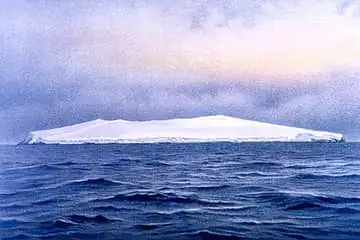
Bouvet Island is a tiny, ice-covered volcanic island in the far South Atlantic Ocean, belonging to Norway. It is often called the most remote island in the world: the nearest land, Antarctica's coast, is about 1,700 kilometres away. No one lives there, and it has no capital or permanent population. The island is only about 49 square kilometres, and nearly all of it lies under a glacier.
On My Earth Toy Bouvet Island appears as a place to discover, a lonely white speck in the stormy ocean between Africa and Antarctica. It is a protected nature reserve, visited only now and then by scientists.
Ice, rock and wildlife
Bouvet Island is the top of a volcano that rises from the seabed near the southern end of the Mid-Atlantic Ridge. Its highest point, Olavtoppen, is about 780 metres above the sea, and the old crater in the middle is filled with ice. Steep cliffs make landing very hard. No trees or grasses grow, only mosses and lichens. But the coast is busy with Antarctic fur seals, elephant seals, and colonies of macaroni and chinstrap penguins.
Who goes there
Nobody lives on Bouvet Island. Since 1971 it has been a nature reserve, so visits are strictly limited. A small terrace on the northwest coast, called Nyrøysa, formed by a rockslide in the 1950s, is the easiest place to land, and an automatic weather station stands there. Scientists from the Norwegian Polar Institute occasionally travel there by ship or helicopter to count seals and seabirds and study the island.
History in a nutshell
The French explorer Jean-Baptiste Charles Bouvet de Lozier spotted the island on 1 January 1739, but he wrote down its position wrongly, so later sailors could not find it again for decades. British sailors sighted it in 1808 and 1825. In 1927 a Norwegian expedition landed and claimed it for Norway, and in 1930 it was declared a Norwegian dependency.
Fun facts
- About nine-tenths of Bouvet Island is covered by glacier ice.
- Bouvet Island has its own internet country code, .bv, even though nobody lives there.
- Bouvet first thought the island might be the tip of a great southern continent.
- Tens of thousands of fur seals breed on the island's coast.
Places to discover in Bouvet Island
Sources
Updated: 2026-10-30