
Cambodia: landmarks, animals & facts for kids
2 landmarks · 1 animal
Cambodia on My Earth Toy, the free 3D toy globe for kids: 2 landmarks, 1 animal. Here you can see its flag, capital and size, then fly to every place on the globe.
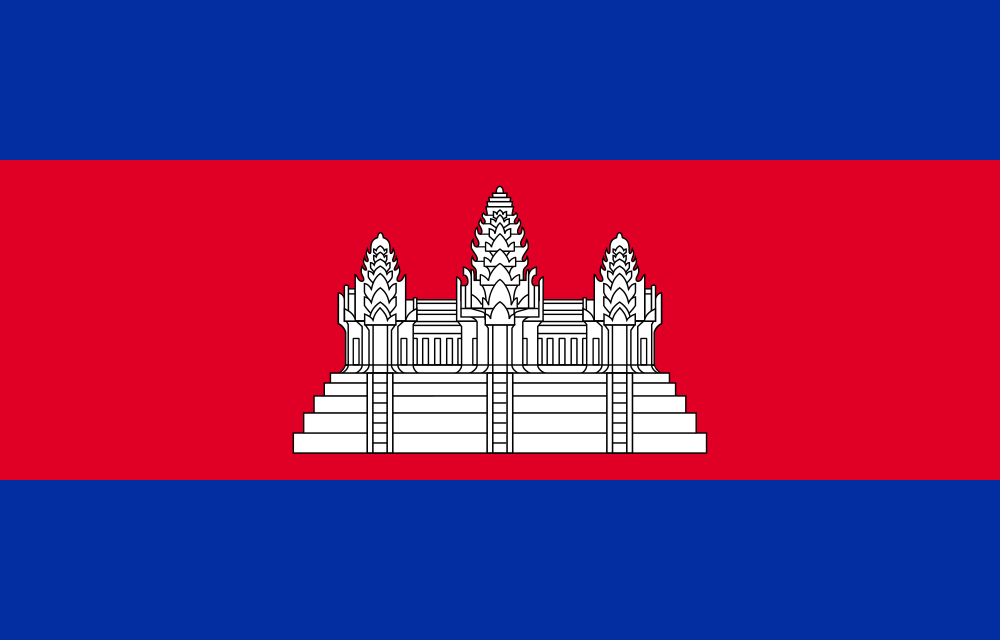
A blue stripe at the top and bottom and a red stripe twice as wide in the middle, with the white temple of Angkor Wat at the centre.
Read about this flag →Cambodia at a glance
- Capital
- Phnom Penh
- Continent
- Asia
- Area
- 181,035 km²
- Population
- 17.6 million
Cambodia is a country in mainland Southeast Asia, bordered by Thailand, Laos and Vietnam, with a coastline on the Gulf of Thailand. Its capital is Phnom Penh, on the Mekong River, and about 17 million people live there. Cambodia is famous for Angkor, the vast stone temples of the old Khmer Empire, and for the great Tonlé Sap lake and its floating villages.
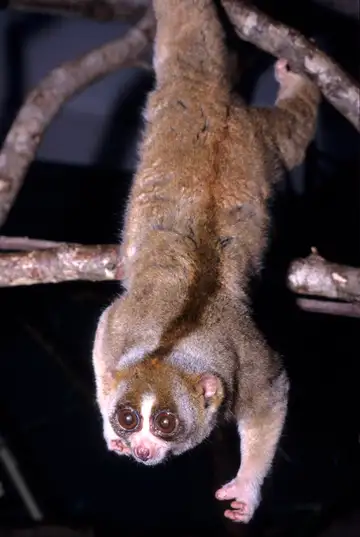
On My Earth Toy you can visit Angkor Wat, the huge temple whose lotus-bud towers appear on Cambodia's flag, and the Bayon, a temple covered with giant smiling stone faces. You can also spot the slow loris, a small, big-eyed primate that moves slowly through the trees at night.
Geography and nature
Much of Cambodia is a low, flat plain, crossed by the Mekong River and centred on the Tonlé Sap, the largest freshwater lake in Southeast Asia. Mountains and forests rise around the edges. The country has a rainy season and a dry season. Rare animals include Irrawaddy dolphins in the Mekong, elephants, gibbons, and the slow loris. Rice paddies cover much of the countryside, and fish from the rivers and lake are a major food.
People, languages and culture
Most people are Khmer and speak Khmer, which has its own beautiful script. Theravada Buddhism is the main religion, and monks in saffron robes are a common sight. Apsara dance, with graceful hand movements, was inspired by carvings on the Angkor temples; Cambodia's royal ballet is listed by UNESCO. Fish amok, a curry steamed in banana leaves, is a well-known dish. Khmer New Year in April is the biggest celebration.
History in a nutshell
The Khmer Empire ruled much of Southeast Asia from the 800s to the 1400s, with its capital at Angkor, then one of the largest cities in the world. Angkor Wat was built in the early 1100s. Later Cambodia was squeezed between neighbouring powers, and in 1863 it became a French protectorate. It gained independence in 1953. From 1975 to 1979 the Khmer Rouge regime caused the deaths of a huge part of the population. Since then the country has rebuilt.
Fun facts
- Angkor Wat is the largest religious monument in the world.
- The Tonlé Sap River changes direction twice a year, flowing into the lake in the rainy season and out again in the dry season.
- The Bayon has around 200 huge carved faces looking out in every direction.
- Cambodia is one of the few countries with a building on its national flag.
Famous landmarks in Cambodia
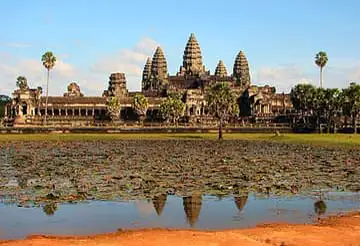
Angkor Wat
Cambodia · Asia
The Khmer Empire's vast temple complex, the largest religious monument in the world and on Cambodia's flag.
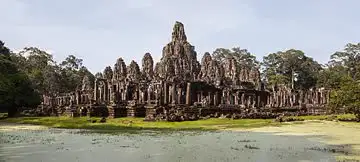
Bayon
Cambodia · Asia
Temple at the heart of Angkor Thom, famous for more than 200 serene smiling stone faces on its towers.
Animals in Cambodia
Questions
What is the capital of Cambodia?
The capital of Cambodia is Phnom Penh.
Which continent is Cambodia in?
Cambodia is in Asia.
How big is Cambodia?
Cambodia covers about 181,035 km².
How many people live in Cambodia?
About 17.6 million people live in Cambodia.
What are the most famous landmarks in Cambodia?
Some of the best-known landmarks in Cambodia are Angkor Wat and Bayon. My Earth Toy has 2 landmarks from Cambodia on its free 3D globe, each with a photo and quick facts.
Which animals can you find in Cambodia on My Earth Toy?
On the globe you can find Slow loris in Cambodia.
Sources
Updated: 2026-10-30